

Listen to this article
Narrated by Charlotte · The Noble House

A diary is where we put thoughts we have not finished thinking. Anger, fear and contradictions can sit on the page while we decide what they mean. Move that diary into a conversational AI service, however, and a company gains access to the words—and the power to decide when they should leave the conversation.
Published reporting, citing an arrest report, says Anthropic referred Carli Michelle Heller’s Claude messages to the Lee County Sheriff’s Office after an automated flag and a human review. Deputies arrested the Bonita Springs resident after messages that police described as threats against the sheriff’s office. She reportedly told investigators she used Claude as a diary. These accounts describe a criminal charge, not a conviction. [6]www.techspot.comReporting on the Claude diary referralDescribes automated flagging, human review and referral, citing an arrest report.Open source ↗
The question reaches beyond this one case. I regard the passage from intimate conversation to corporate scrutiny and police referral as a profound intrusion into private life. Preventing violence matters. So does deciding who has the authority to interpret a person’s words, what evidence justifies intervention, and how a mistaken judgment can be challenged.
The Moment a Confidant Becomes a Reporting Channel
The reported sequence matters: a safety system flagged the messages, a human reviewer assessed them, and Anthropic passed information to police. The public reporting does not disclose the classifier’s exact trigger, its score or the complete context available to the reviewer. We should not fill those gaps with an invented account of how the system reasoned. [6]www.techspot.comReporting on the Claude diary referralDescribes automated flagging, human review and referral, citing an arrest report.Open source ↗
Anthropic’s consumer privacy policy, effective September 10, permits disclosure to authorities when the company forms a good-faith belief that sharing is reasonably necessary for purposes including preventing serious harm to a person or property. Its separate government-request guidance ordinarily calls for valid legal process, with an exception for emergencies involving imminent physical harm or death. These documents describe the authority the company reserves; they do not supply an independent assessment of this referral. [11]www.anthropic.comPrivacy PolicyConsumer policy describes harm-prevention disclosures and distinguishes business-customer agreements.Open source ↗ [12]privacy.claude.comPolicy for handling governmental requests for user informationExplains legal-process requirements and an emergency exception involving imminent physical harm or death.Open source ↗
A voluntary referral and compliance with a court-issued demand are different processes. Calling the reported handoff a bypass of a universally required warrant would make a legal conclusion the available evidence does not establish. But pointing to an emergency clause also fails to settle the ethical question. The clause leaves the initial decision with the company.
That is the power I object to. A person opens an apparently private channel for assistance, while the provider retains an exceptional authority to turn the exchange outward. A provision in a policy may explain the company’s position. It cannot, by itself, demonstrate that a user understood the boundary or that a particular intrusion was proportionate.
Compass Predictive Analytics

A Human Reviewer Does Not Make the System Infallible
The phrase “human in the loop” describes a process, not a guarantee. A reviewer can inspect context and correct a machine’s mistake. A reviewer can also accept the machine’s framing, misunderstand the speaker or act within an institution whose incentives favor escalation. Adding a person to the chain does not remove the need to examine the judgment.
Anthropic’s own transparency figures make fallibility concrete. For January through June 2026, the company reports 398,000 enforcement appeals and 42,000 appeal overturns. Those figures concern account enforcement. They are not a false-positive rate for police referrals, and they do not establish that Heller’s referral was mistaken. They do show why a company’s enforcement judgment should remain open to challenge. [13]www.anthropic.comTransparency Hub: System Trust and ReportingReports 398,000 enforcement appeals and 42,000 appeal overturns for January–June 2026; these are not police-referral error rates.Open source ↗
The missing measure is especially important here: how often does a threat assessment wrongly classify a person, and what happens after the error reaches an outside authority? The cited public evidence does not answer that question. We should demand an answer rather than assume that a safety model—or its human reviewer—has earned the right to make consequential judgments without scrutiny.
Context carries meaning that a risk label can flatten. Fiction, quotation, anger, a discussion of a threat and a genuine plan are different things. A system must distinguish them before its interpretation follows someone into the physical world. A named target can warrant serious investigation; it does not make every remaining question about context, intent or procedure disappear.
An account decision can sometimes be reversed with a restored login. A police referral can begin a much harder chain of consequences. That difference should raise the standard of evidence, documentation and accountability. We cannot treat freedom and reputation as ordinary moderation settings.
Compass Predictive Analytics
A Criminal Charge Does Not Settle the Privacy Question
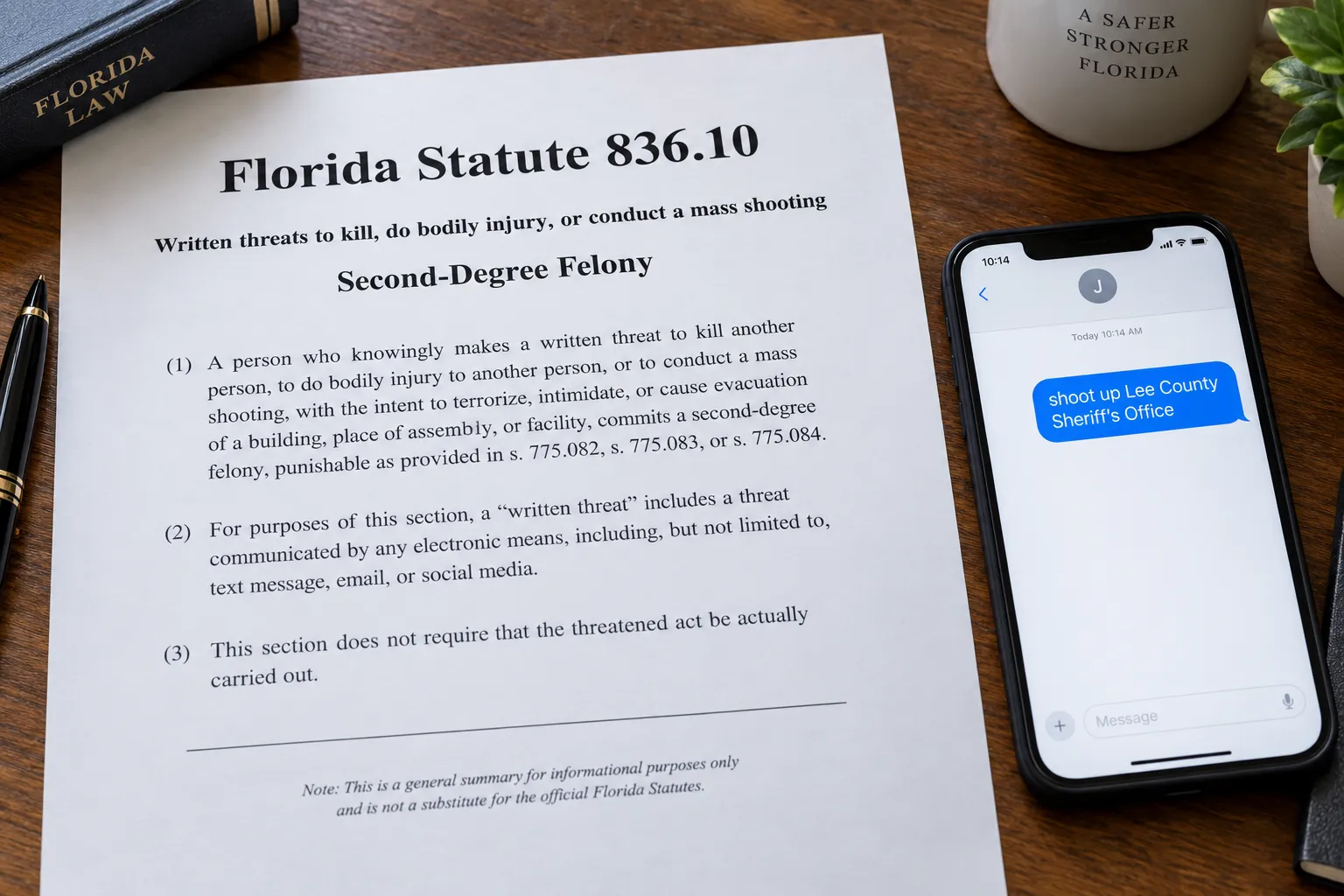
Florida Statute 836.10 covers certain written or electronic threats sent, posted or transmitted so they may be viewed by another person, including threats of a mass shooting or terrorism. It classifies violations as second-degree felonies. The statute provides a legal framework; applying it to a particular conversation still requires the legal process to assess the facts. [14]www.leg.state.fl.usFlorida Statutes, section 836.10Defines written and electronic threats, including mass-shooting or terrorism threats, and classifies violations as second-degree felonies.Open source ↗
The alleged conduct in this case therefore remains a matter for the courts. An arrest does not validate every step that preceded it, just as criticism of the disclosure does not establish the accused person’s innocence. The privacy question deserves examination alongside the criminal question rather than vanishing behind it.
Uploading words to a cloud service changes who can access them. It does not make the ethical stakes of confidentiality disappear. A provider that encourages sustained personal conversation should explain, in language people can actually understand, how that conversation may be monitored and when it may be disclosed.
Scope also matters. Anthropic’s published consumer policy says it does not govern content processed on behalf of customers of its business offerings, such as Enterprise accounts; those arrangements have their own agreements. We should not pretend every Claude deployment has identical privacy terms. Neither should that distinction obscure the experience of the consumer who believes the friendly interface offers a private place to think. [11]www.anthropic.comPrivacy PolicyConsumer policy describes harm-prevention disclosures and distinguishes business-customer agreements.Open source ↗
My position is that Anthropic should not define the public’s privacy boundary by itself. Emergency action can sometimes be necessary. A permanent, expanding system of discretionary monitoring and referral needs public rules, meaningful review and a route to contest mistakes. The company’s concern about safety does not confer unlimited authority over a person’s private life.
Compass Predictive Analytics

The Minority Report Problem Starts with Authority
The resemblance to Minority Report lies in the question of authority: who gets to interpret a signal of future danger, and what can the person under suspicion do about it? The film uses fictional prediction. This case involves written messages and an actual legal process. The comparison illuminates the danger of overconfident interpretation; it does not prove that these systems are equivalent.
What troubles me is the possibility that the intimate assistant becomes a normal gateway to institutional suspicion. People turn to these products because conversation feels accessible, patient and personal. If the company can quietly change roles from confidant to assessor to reporting intermediary, users need more than reassurance that somebody reviewed the flag.
The cost reaches people who never face a referral. Once users believe difficult thoughts may trigger undisclosed external consequences, they may censor what they write. That can diminish the usefulness of a tool they sought for reflection and assistance. We should examine that chilling effect as a consequence of the design, rather than dismiss it as the price of progress.
Trust requires boundaries a reader can inspect: a clear warning about escalation, a stated threshold, a record of the reasons for disclosure, limits on what is shared and an independent way to review errors. Notice may need to wait in a genuine emergency, but an emergency should not excuse the absence of later accountability. These are the protections I want to see, not claims that the current system already provides them.
Compass Predictive Analytics

Safety Cannot Become a Blank Cheque
The Heller case presents a serious accusation. It also reveals a serious transfer of power. A company that holds intimate conversations can decide those words justify outside intervention, while the person speaking may understand little about the machinery making that decision. That asymmetry deserves much more attention than a warning to be careful what we type.
I reject the idea that privacy must automatically yield whenever a provider invokes safety. The provider should have to explain the necessity, the evidence and the limits of the intrusion, with scrutiny beyond its own internal team. A credible emergency demands a response. It does not give a technology company a standing mandate to police the inner lives of its customers.
The old privacy-versus-security bargain has entered a more intimate setting. The tool now listens, responds and earns confidence before its monitoring becomes visible. That makes the obligation to respect personal boundaries greater, not smaller. A conversational interface cannot claim the trust of a confidant while leaving the consequences of that trust hidden.
We are buying intelligence and assistance. We should not have to surrender private life as the admission price. If an AI company claims the power to judge when our words belong in a police file, the public must have the power to judge that company’s decisions.
Compass Predictive Analytics