

Listen to this article
Narrated by Charlotte · The Noble House

Imagine being asked to show an AI how you do your job. Not just the steps in the manual, but the things experience taught you: which answer to question, which customer needs a different approach, where an apparently simple request can go wrong. You can see how useful this could become. You can also see the question nobody has answered: once the system knows what I know, what happens to me?
That question follows you home. It reaches the rent or mortgage, your children’s plans, the years spent earning a qualification and the confidence with which you made promises about tomorrow. A manager may call this an adoption challenge. You may experience it as uncertainty about the life your work supports.
We should be able to take that fear seriously while believing in AI’s possibilities. Helping a system become more capable is an invitation to collaborate. When the person contributing the knowledge has little control over what happens afterward, it can also feel like being asked to help make their own position easier to eliminate. A credible future for human–AI collaboration has to address both realities.
Compass instruments track the original adoption signal. The research discussed here uses its own samples, dates and measures.
Compass Predictive Analytics

The fear has a life behind it
For many people, the promise attached to work has been recognizable: learn, acquire a skill, contribute, and build a life with some stability. It was never a guarantee, and it did not work equally well for everyone. But it gave effort a direction. The unsettling possibility now is that doing your job exceptionally well could include teaching a system to do enough of it without you.
‘Make yourself indispensable’ sounds different under those conditions. Your judgment may remain valuable, but valuable to whom, and on what terms? If it can be captured in a workflow while decisions about employment remain elsewhere, being useful does not necessarily give you security. You may be transferring your knowledge at the expense of your future.
This concern is not merely an imagined mood. In Pew Research Center’s survey of 5,273 employed U.S. adults, conducted in October 2024 and published in February 2025, 52% said they were worried about future workplace AI use. Thirty-two percent expected fewer job opportunities for themselves over the long run. Those figures describe that survey, not a claim that most Americans reject every use of AI today. They show why a message about productivity can land as a question about survival. [19]www.pewresearch.orgWorkers’ views of AI use in the workplaceAmong surveyed employed U.S. adults, 52% expressed worry about future workplace AI use and 32% expected fewer opportunities for themselves.Open source ↗
The original social-media observation behind this essay described a practitioner’s experience six months into rollouts, where people hesitated to report problems. It was an anecdote, not an adoption timetable. Read through the employee’s position, it raises a deeper question: why volunteer more knowledge to a process if you cannot tell whether its success will include you? [1]www.reddit.comOriginal Reddit observation: six months into AI adoptionDiscovery context and practitioner anecdote; not a controlled study or an established adoption timetable.Open source ↗
Compass Predictive Analytics

The same technology can mean freedom to one person and insecurity to another
I see another possibility because I am building Compass through collaboration with AI. It helps me research, develop ideas, create tools and carry work into forms I could not practically produce alone. My taste, judgment and purpose remain part of the process. The technology gives those qualities more room to act. I decide what we are trying to build, challenge the result and determine whether it serves the people I want to reach.
That experience is why I do not accept a simple argument that AI is bad for humanity. It can make one person capable of undertaking work that once seemed beyond reach. It can help a founder build a business, a specialist reach more people, or a small team pursue ideas it previously lacked the capacity to develop. The possibility is personal as well as economic: more of what you imagine can become something real.
But my position differs from the employee’s. I have control over the project and a stake in what its growth produces. An employee may help create a capability while someone else decides whether it will support their next role or remove their current one. The model alone cannot resolve that difference. Ownership, decision-making power and the distribution of gains shape the experience.
A humane future cannot require everyone to become a founder to retain agency. People who choose employment should also have a meaningful place in the capabilities they help build. The challenge is to carry the opportunity I experience into workplaces where employees can benefit from augmentation without having to gamble their livelihood on an employer’s intentions.
Compass Predictive Analytics

Paying for my work is different from buying a substitute for me
At hiring, the employer assesses the value of what you can contribute, and you agree on compensation for applying it. The output of that work may belong to the employer. But paying for your services does not, by itself, answer the fairness of deliberately capturing your expertise in a capability that can keep producing value without employing you.
That expertise has a history. You paid for education, learned from other people, took responsibility for decisions and developed judgment through experience. Over time, the combination became more useful. Turning it into a reusable automated capability can change the transaction: the company may keep the benefit while your ability to earn from applying it becomes less valuable.
Consider the economic logic of a non-compete in reverse. An employer worries that you might take your expertise elsewhere and compete with it. Now you worry that the employer will capture enough of that expertise to create a system that competes with your own services. This is an analogy about bargaining power, not a claim that current law grants a reciprocal right against automation.
Here is a proposal worth testing: when a company deliberately asks people to help encode their expertise into a durable substitute for their services, it should negotiate the terms of that contribution. An upfront payment, continuing license fee, share of the value created, employee equity or a collective contribution fund could make the arrangement more equitable. The question becomes: if my contribution keeps creating value after my job ends, why must my participation end with it?
This would be a proposed protection, not an automatic royalty entitlement under existing copyright law. Copyright protects expression rather than general methods or knowledge, and qualifying employee work can belong to the employer. A workable agreement must distinguish personal know-how from public knowledge, team contributions and company-owned material. It should cover identifiable, deliberate knowledge capture rather than every ordinary exchange between colleagues. New legislation or collective agreements could establish minimum protections where individual bargaining power is weak. [21]www.copyright.govWhat is Copyright?Copyright protects expression, not general ideas or methods. Qualifying work made for hire can belong to the employer; the proposed knowledge-capture compensation is a separate policy and contractual idea.Open source ↗
Compass Predictive Analytics
Hollywood shows what a negotiated answer can look like
We do not have to imagine every protection from scratch. Hollywood’s unions have negotiated parts of the bargain we are describing. Their agreements offer one avenue for the rest of us: identify what must be protected, make the terms explicit, and give workers a collective means of enforcing them.
The Writers Guild’s AI rules protect human credit and compensation on covered projects and prevent companies from requiring writers to use AI software. Its 2026 agreement adds notice and discussion rights for specified paid third-party licenses of covered writing for public-facing commercial AI training, including discussion of remuneration. That is a bargaining opening, not a guaranteed royalty. [24]origin.www.wga.orgArtificial Intelligence: MBA protectionsCovered writers retain protections for human credit and compensation; companies cannot require writers to use AI software.Open source ↗[25]www.wga.org2026 MBA Memorandum of AgreementSpecified paid third-party licenses for public-facing commercial GAI training trigger notice and discussion rights, including remuneration if any; no guaranteed royalty.Open source ↗
SAG-AFTRA’s ratified 2026 TV/Theatrical agreement provides another example. Its summary establishes minimum pay for independently created digital replicas and residuals when the resulting performance would qualify a human performer for them. A reusable digital contribution can therefore remain connected to compensation under defined contractual conditions. [26]www.sagaftra.org2026 TV/Theatrical Agreement: AI protectionsSection 39.C sets minimum compensation for independently created digital replicas and residuals where the performance qualifies. Ratification is confirmed by the union.Open source ↗
IATSE’s 2024 Basic Agreement reaches particularly close to the employee’s fear. Producers retain the right to require AI use, but cannot require employee-furnished prompts in bargaining-unit work in a manner that displaces a covered employee. The same agreement provides for negotiating reasonable reimbursement when a producer agrees to use an employee’s own AI system. [27]iatse.net2024 Basic Agreement Memorandum of AgreementThe agreement limits compelled employee-furnished prompts that displace covered employees, requires negotiated reimbursement for agreed employee-owned AI use, and limits arbitration remedies.Open source ↗
These protections are bounded. They do not cover every worker or forbid virtual production, and IATSE’s arbitrator cannot prohibit an AI system or its outputs. But they demonstrate something concrete: collaboration’s terms can be negotiated. Consent, compensation, limits on compelled displacement and enforceable representation need not remain hopeful language in a launch presentation. The challenge is extending credible protections to people who lack comparable bargaining power. [27]iatse.net2024 Basic Agreement Memorandum of AgreementThe agreement limits compelled employee-furnished prompts that displace covered employees, requires negotiated reimbursement for agreed employee-owned AI use, and limits arbitration remedies.Open source ↗

What will the owners do with the gains?
The World Economic Forum’s Future of Jobs Report 2025 captures the tension. Among surveyed employers worldwide, 41% expected workforce reductions as AI’s ability to replicate roles expanded, while 77% planned to reskill or upskill existing workers to work alongside AI by 2030. These were reported intentions, not completed layoffs or assured retraining. The two approaches can coexist within the same organization. [20]www.weforum.orgThe Future of Jobs Report 2025: Workforce strategiesSurveyed employers reported plans both to reskill existing workers for AI and to reduce workforces as AI can replicate roles. These are intentions, not completed outcomes.Open source ↗
There is a choice inside those intentions. A business can use greater capacity to reach customers it previously could not serve, improve its service, develop new products and give its people more demanding work. It can also seek the same output with fewer people, concentrating the savings among those who control the business. Competition, demand and financial constraints influence that choice. They do not erase its consequences for the people whose experience helped make the system useful.
When the aim becomes extracting the employee’s expertise and retaining the resulting income while discarding the person, the objection is about the bargain being offered. Calling it progress does not settle the question of who progresses. Nor does a promise of eventual abundance explain how the affected family gets through the intervening years.
A business must remain viable. Some work will change, and some roles may disappear even under responsible management. The case for collaboration cannot rest on promising that nothing will ever change. It has to rest on making the transition more credible: involving people before decisions are finalized, giving them time and support to learn, creating real routes into new work, and explaining how they can share in the value they help generate.
Compass Predictive Analytics
Silence can be a form of self-protection
An employee can be asked to use AI and still feel unsafe discussing it. Research by Jessica Reif, Richard Larrick and Jack Soll found, across four preregistered experiments with 4,439 participants, that AI users anticipated and received negative judgments about competence and motivation. Duke’s explanation also identifies limits: managers’ own AI experience and the fit between the tool and task influenced the penalty. The evidence concerns social evaluation, not proof that reporting an error will get someone fired. [11]doi.orgEvidence of a social evaluation penalty for using AIFour preregistered experiments, N=4,439, examine anticipated and observed social evaluations of AI use.Open source ↗[12]www.fuqua.duke.eduIs AI Damaging Your Professional Image?The researchers explain how managers’ AI experience and task fit influence the social penalty.Open source ↗
Now consider the employee who is already worried about replacement. Admitting to using AI may invite judgment. Reporting its failure may be read as resistance. Helping it succeed may make more of the job transferable. Our interpretation is that those incentives can make quiet cooperation or concealed correction feel safer than an honest conversation. A dashboard can register activity while missing the person’s unease.
Amy Edmondson’s study of 51 manufacturing teams linked psychological safety with learning behavior. Published in 1999, it is not an AI adoption forecast, but its mechanism remains relevant: people need room to ask for help and acknowledge mistakes if the team is to learn. [13]dash.harvard.eduPsychological Safety and Learning Behavior in Work TeamsA study of 51 manufacturing teams links psychological safety with team learning behavior.Open source ↗
For a worker, ‘speak up’ needs something behind it. Who will hear the concern? What protection exists for good-faith reporting? Who can correct the problem? What happens if the criticism concerns the deployment’s effect on employment, rather than the accuracy of one answer? A process that welcomes bug reports but excludes the question of people’s futures has only opened part of the conversation.
There is a future worth collaborating on
Useful gains are real. The revised Generative AI at Work study reports a 15% average rise in issues resolved per hour across 5,172 support agents, with larger benefits for less experienced workers. A separate six-month experiment across 66 firms found email time savings among active treated users without detected broader task changes. Neither result decides who receives the benefits. That remains an organizational choice. [14]arxiv.orgGenerative AI at WorkThe revised study reports 5,172 support agents and a 15% average increase in issues resolved per hour, with heterogeneous effects.Open source ↗[16]arxiv.orgShifting Work Patterns with Generative AIA six-month field experiment covers 66 firms and 7,137 workers; active treated users saved time on email, without detected broader task shifts.Open source ↗
A support specialist could use the recovered time to resolve difficult cases. A small team could serve a wider market. A founder could spend fewer evenings on administration and more on the product they want to offer. These possibilities depend on how the work is organized—and on systems whose results can actually be trusted.
The BCG experiment found gains on suitable tasks and poorer correctness on a task beyond the tested AI frontier. METR’s developer studies likewise show why perceived speed and measured completion must be distinguished, with newer-tool estimates subject to important limitations. Examine the actual work. [15]doi.orgNavigating the Jagged Technological FrontierThe experiment finds gains on suitable tasks and a 19-percentage-point correctness decline on a task outside the tested AI frontier.Open source ↗[17]metr.orgMeasuring the Impact of Early-2025 AI on Experienced Open-Source Developer ProductivitySixteen developers completed 246 tasks. AI access increased completion time by 19% in this specific setting.Open source ↗[18]metr.orgWe are Changing our Developer Productivity Experiment DesignMETR reports possible newer-tool speedups while explaining selection and measurement problems that prevent a reliable current effect estimate.Open source ↗
Give the model dependable sources, clear permissions, useful tools, consequential-error checks and a route back to human judgment. Keep failure cases and verified remedies. Count review, correction, retries and intervention in the cost of an accepted task. Then ask the human question again: who benefits from the capacity that improvement creates?
| The human question | A credible commitment | What to look for |
|---|---|---|
| Will helping the system improve put my future at risk? | Discuss employment implications before extracting more expertise | People have a voice in the deployment and clarity about intended changes |
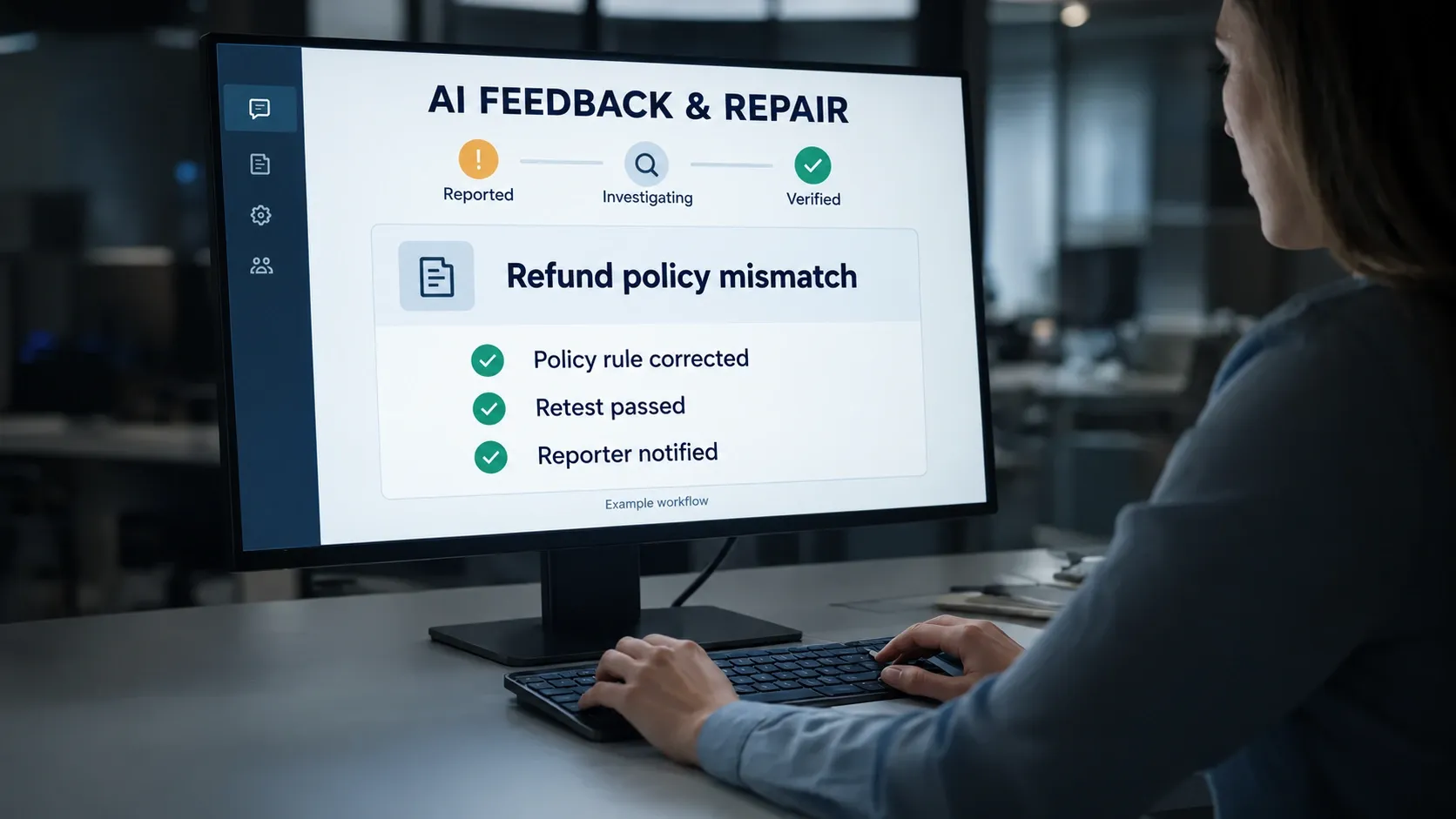
| Can I raise a concern without being punished for it? | Protect good-faith reporting and name someone responsible for responding | Concerns receive substantive answers, including questions about jobs |
| What happens when my expertise becomes a reusable capability? | Negotiate the contribution, reuse, compensation and transition terms | The contributor has an identifiable stake and a way to verify the agreement |
| What do I gain from the productivity I help create? | Agree how improvements will support employees as well as the business | Benefits appear in progression, compensation, working time or other defined terms |
Who will buy the abundance?
If businesses can produce more with fewer people, another question follows them out of the workplace: who can afford what they produce? The displaced worker is also a customer. Cheaper production does not automatically put income into that household. Lower prices, new jobs and investment may help, but none guarantees that the gains arrive where income was lost.
A promise of high universal income therefore needs a funding mechanism and a credible standard of living. MIT’s 2026 California estimate for two working adults and two children is $151,355 before taxes. That is a modeled basic-needs budget under stated assumptions, not a federal poverty threshold or the cost for every family. It illustrates why a headline payment alone cannot tell us whether a household could actually live on it. [22]livingwage.mit.eduLiving Wage Calculation for CaliforniaThe estimate for two working adults and two children is $151,355 in household income before taxes under the calculator’s assumptions, not a poverty threshold.Open source ↗
Taxation and broader ownership are possible bridges. IMF staff research argues for strengthening capital-income taxation as AI could reduce labor’s share of income, while improving social protection. Income could also reach people through employee ownership, negotiated participation payments or dividends from public investment funds. These are mechanisms to examine, not evidence that any particular level of universal income can be sustainably financed in every country. [23]www.imf.orgBroadening the Gains from Generative AI: The Role of Fiscal PoliciesThe authors discuss stronger capital-income taxation and social protection to broaden AI gains. The note does not establish that a particular universal-income promise is affordable.Open source ↗
The missing agreement is about how productive gains become purchasing power and opportunity for people. A safety net matters for those who cannot establish an individually traceable contribution. Participation matters too: people should have ways to benefit from the capabilities they help build, rather than depend entirely on a later promise that somebody will redistribute enough to keep them afloat.
A place in the future should mean more than permission to watch it arrive
For the employee reading this, concern about your future does not make you incapable of learning or hostile to progress. You can want the technology to succeed and still ask whether you will have a place in that success. Ask what happens to your role as its tasks change, what support exists to develop new capabilities, and who decides how the gains are used. Those are questions about collaboration’s terms.
For the founder or employer, consider the possibility of expanding with your people. Their knowledge can help build the system, and their relationships, judgment and ambition can help decide what to do with the capacity it creates. If you retain only the instructions while losing the people who understand the work, you may be discarding part of what could have made the next stage valuable.
Governments and public institutions face a similar responsibility. Improving service and using resources well are legitimate aims. People affected by the transition still need credible opportunities to learn, earn and participate. The costs cannot simply be assigned to individual households while the benefits remain someone else’s success story.
None of this removes uncertainty. We do not yet know how far these systems will advance, which new roles will become durable or how widely the gains will spread. That is a reason to make commitments we can examine now: who receives training, who moves into meaningful work, who has influence over deployment, and whether the benefits reach the people who helped create them. Hope becomes more believable when it begins producing evidence.
The person teaching the system deserves a place beside it
I want people to experience the possibility I see in this collaboration: an idea becoming a product, a difficult task becoming manageable, an ambition no longer confined by what one person can accomplish alone. AI can help us reach further. The purpose of reaching further should include the people whose lives give that progress meaning.
Hollywood’s example makes that ambition more concrete. People have negotiated terms around credit, compensation and digital reuse rather than leaving everything to assurances of goodwill. Those protections remain limited, but they give us a starting point for asking what a fair agreement could look like in other workplaces. A future worth building should give people ways to influence it.
So when someone asks whether they are automating themselves out of a future, hear the family and commitments behind the question. Give them a voice, a stake and a path into the capabilities they help create. Let a reported failure lead to a better system, and let a valuable contribution lead to a more credible opportunity—not simply a farewell after the knowledge has been captured.
The promise of human–AI collaboration becomes worth defending when a person can look at a more capable system and see more possibility in their own life. That possibility deserves terms people can understand, negotiate and trust. The person helping build tomorrow should be able to imagine themselves living in it.