

Listen to this article
Narrated by Charlotte · The Noble House

On October 12, 2026, Meta unveiled the Muse Wonder series, introducing two new frontier models designed to power agentic workflows [1]about.fb.comIntroducing Muse Wonder and Muse Wonder Full: Frontier Models for AgentsMuse Wonder is available today for developers and builders through the Meta Model API and Muse Code while Muse Wonder Full is available today for Muse Code subscribers.Open source ↗[10]unite.aiAI Connect with us Search Meta on October 12, 2026 announced the Muse Wonder seriesAI Connect with us Search Meta on October 12, 2026 announced the Muse Wonder series, introducing Muse Wonder and Muse Wonder Full as frontier models for personal and professional agentic tasks.Open source ↗. The company describes Muse Wonder and Muse Wonder Full as its most capable models to date, built to deliver state-of-the-art performance on personal and professional tasks ranging from navigating insurance claims to building working applications [1][10]. Meta says the release follows a fourteen-month overhaul in which it went from rebuilding its foundations to pushing the frontier [1]about.fb.comIntroducing Muse Wonder and Muse Wonder Full: Frontier Models for AgentsMuse Wonder is available today for developers and builders through the Meta Model API and Muse Code while Muse Wonder Full is available today for Muse Code subscribers.Open source ↗. The announcement signals Meta’s intent to reestablish itself as a major force in AI through aggressive infrastructure investment and a focus on utility-driven agents [3].
Model Capabilities and Technical Architecture
The Muse Wonder series is engineered specifically for agentic workflows, emphasizing features that allow AI systems to operate autonomously over complex, long-running tasks. Meta introduced two key capabilities: Active Memory and Active Focus [4]androidauthority.comMeta wants Muse to keep up with ChatGPT and Gemini, and Wonder is howMeta's new Muse Wonder models are built for AI agents, with Active Memory, Active Focus, and stronger agentic capabilities.Open source ↗. Active Memory enables the model to carry important context across conversations and retrieve relevant details for the task at hand [2]research.meta.aiMuse Wonder availability announcementMuse Wonder is available today through the Meta Model API and Muse Code, and Muse Wonder Full is available today for Muse Code subscribers.Open source ↗. Active Focus allows the model to sustain effort toward a goal when obstacles arise, including trying alternative approaches, recovering from errors, and checking in with users before taking important actions [10]. Wang said Meta trained the model to try other approaches instead of stalling when a task hits roadblocks [5]cnbc.comMeta debuts Muse Wonder AI model in latest test of users' willingness to payMeta introduced Muse Wonder, its latest AI model, but users have to pay for subscriptions to the Muse platform.Open source ↗.
Coding performance is a central component of the Muse Wonder architecture. Meta trained both models on diverse, long-running tasks to support software development projects ranging from small applications to complex systems [2]. The models demonstrate frontier coding capabilities, which are critical for developers building everything from games to business apps [10]. Independent benchmarking by Artificial Analysis indicates that Muse Wonder Full places in the top three on six of ten Intelligence Index evaluations, showing particular strength in agentic knowledge work and scientific reasoning [11]mashable.comMeta launches Muse Wonder, catching OpenAI and Anthropic at the frontierThe Muse AI assistant is about to get even smarter — for a price.Open source ↗. Meta claims the models achieve state-of-the-art results across key benchmarks for personal and professional agents, memory, and coding [10].
The technical foundation of these models relies on a gigawatt-scale data center named Prometheus, where both Muse Wonder and Muse Wonder Full were trained [10]. This infrastructure supports the heavy computational requirements of frontier AI development. Meta’s research blog highlights that the Muse Wonder series builds upon groundwork laid with the earlier Muse Spark models, applying rigorous scaling approaches across pretraining and reinforcement learning [2]. The company reports that Muse Wonder Full performs better on unfamiliar tasks than previous trends would predict, attributing this improvement to larger, stronger base models that carry post-training gains more effectively to out-of-distribution tasks [10]. This versatility is essential for personal agents that must handle unpredictable combinations of goals, tools, and constraints.
Compass Predictive Analytics
Compass Predictive Analytics

Competitive Landscape and Market Positioning
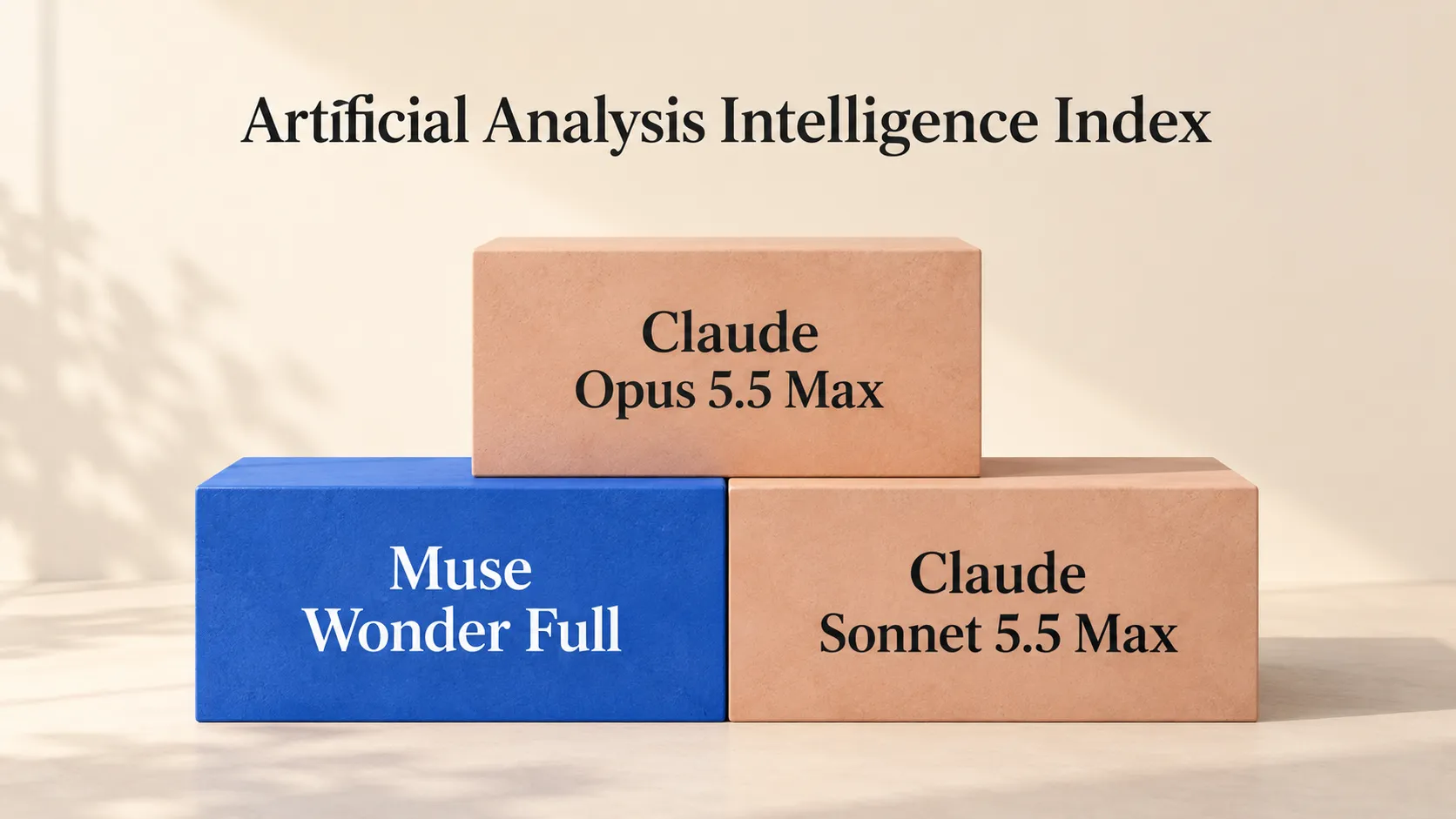
The introduction of Muse Wonder positions Meta directly against Anthropic’s Claude Opus 5.5 and OpenAI’s GPT-6 models [3]. SiliconANGLE reported that Anthropic released Claude Opus 5.5 on September 22, 2026, followed shortly by OpenAI’s release of two cheaper GPT-6 models, Sol and Luna [12]siliconangle.comAnthropic releases Claude Opus 5.5 and OpenAI counters with two cheaper GPT-6 modelsAnthropic PBC released Claude Opus 5.5 despite rampant worries about runaway artificial intelligence.Open source ↗. Meta’s announcement attempts to catch up to these competitors, with independent benchmarks suggesting Muse Wonder has leapfrogged powerful models like GPT-Astra and Fable 5 from their respective creators [11]. On the Artificial Analysis Intelligence Index leaderboard, Muse Wonder Full is second only to Claude Opus 5.5 Max and tied with Claude Sonnet 5.5 Max [11].
Meta claims that Muse Wonder and Muse Wonder Full scored nearly as well as Anthropic’s most advanced models on tests measuring reasoning, writing, and coding [6]seattletimes.comMeta unveils new series of advanced AI modelsThe two new models, called Muse Wonder and Muse Wonder Full, scored nearly as well as Anthropic's most advanced models on tests that measure reasoning, writing and coding, according to data provided by Meta.Open source ↗. However, VentureBeat notes that while the models achieve frontier performance, only the weaker Muse Wonder model is available via the Meta Model API, while the more powerful Muse Wonder Full is restricted to subscribers [7]venturebeat.comMeta's new Muse Wonder and Muse Wonder Full models achieve frontier performanceSource: Meta's Muse Wonder Model Card, October 12, 2026. Scores are at maximum reasoning effort.Open source ↗. This distinction highlights a strategic tiering in Meta’s product rollout. The company has poured billions into talent and infrastructure, including paying $14.3 billion for Scale AI and naming Alexandr Wang chief AI officer, after setbacks in developing the technology [6][11]mashable.comMeta launches Muse Wonder, catching OpenAI and Anthropic at the frontierThe Muse AI assistant is about to get even smarter — for a price.Open source ↗.
The competitive dynamics are further complicated by Google’s Gemini 4 Argon, whose capabilities are still emerging [3]. Mashable reports that Muse Wonder places Meta firmly at the AI frontier for the first time, after previously being considered an afterthought in the market [11]. This shift is attributed to the success of the Muse agent app, which surpassed five million downloads shortly after launch [11]. The release of Muse Wonder serves as a critical test of whether Meta can sustain its momentum against entrenched rivals like OpenAI and Anthropic.
Compass Predictive Analytics
Availability, Pricing, and Subscription Strategy
Meta has launched Muse Wonder with specific availability constraints and pricing tiers that reflect its strategy to generate revenue from AI services outside of online advertising [5]cnbc.comMeta debuts Muse Wonder AI model in latest test of users' willingness to payMeta introduced Muse Wonder, its latest AI model, but users have to pay for subscriptions to the Muse platform.Open source ↗. Muse Wonder is available today for developers and builders through the Meta Model API and Muse Code [1]. Muse Wonder Full is available today exclusively for Muse Code subscribers [2]. This tiered access model allows Meta to capture value from professional users while maintaining broader developer engagement through the API.
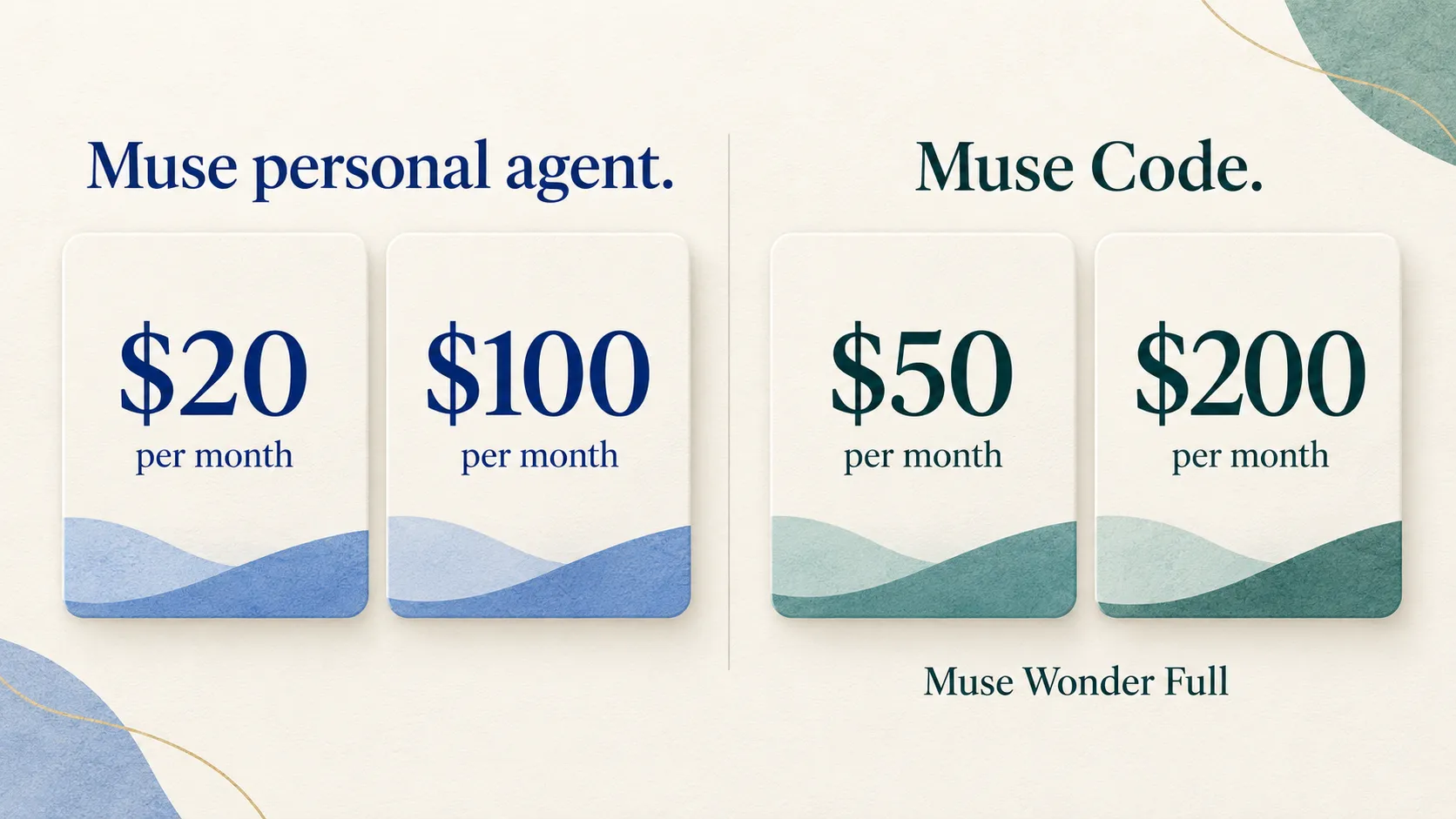
For consumer users, accessing Muse Wonder within the Muse personal agent app requires a monthly subscription plan of $20 or $100 [5]. These pricing plans represent a significant test of users' willingness to pay for AI subscriptions, as reported by CNBC [5]. The Muse app itself is free to download, but advanced capabilities are gated behind these paid tiers. Muse Code, the software engineering-focused agent, offers subscription plans at $50 or $200 per month for access to Muse Wonder Full [9]ithinkdiff.comMeta Muse Wonder AI Model Launches With $20 and $100 PlansMeta has launched Muse Wonder and Muse Wonder Full, two AI models it describes as its most capable to date.Open source ↗. Alexandr Wang said the API pricing will be meaningfully below leading models from OpenAI and Anthropic [5].
The subscription model underscores Meta’s efforts to create new AI-derived revenue sources. The company has already sold paid AI tools in its social apps through Meta One plans, but the Muse series represents a dedicated frontier product line [9]. Wang emphasized that the larger model available via API will be priced higher than standard subscriptions due to its frontier-level capabilities [5]. The rollout of Muse Wonder to power experiences in Muse starts first with subscribers, indicating a phased approach to broader availability [2].
Compass Predictive Analytics
Safety, Alignment, and Risk Management
Meta has emphasized safety and alignment as core components of the Muse Wonder series. The company trained the models to avoid sharing private information without permission and to turn down requests to assist in performing harmful acts [1]. This focus on discretion is critical for personal agents that handle context such as messages, calendars, and private documents [2]. Meta claims the Muse Wonder family offers its strongest safeguards to date against chemical, biological, radiological, nuclear, and cyber misuse [9]. The models are designed to preserve access to frontier cyber capabilities for defensive use while preventing malicious exploitation [10].
Safety evaluations included in Meta’s research blog cover unauthorized code execution attack success rates, personal-information handling violation rates, and biological-risk refusal rates [10]. Meta trains, evaluates, and releases its most capable AI models in line with the standards set out in its Meta Superintelligence Scaling Framework [1]. The company stated that a full report with additional safety evaluations will be available soon, indicating ongoing transparency efforts [2]. Wang addressed complaints from some Muse users regarding unauthorized access to personal messages, disputing those claims and suggesting users may have forgotten earlier authorizations within conversations [9].
The models are built to support expert domains including law, finance, and health, which require high levels of accuracy and reliability [8]seekingalpha.comMeta launches Muse Wonder AI models for law, finance & healthMeta launches Muse Wonder AI models for law, finance & health—built for legal review, claims and coding with memory and safety features.Open source ↗. Meta’s evaluations include tasks in these sectors, such as the Harvey’s Legal Agent Benchmark, which tests the ability to work with source documents and produce legal work products [10]. By ensuring the models can handle complex professional tasks safely, Meta aims to build trust among enterprise and consumer users. The company’s approach to alignment is central to its vision of personal superintelligence, seeking to empower users while mitigating risks associated with autonomous agents [2].
Compass Predictive Analytics

Strategic Assessment and Conclusion
Meta’s launch of the Muse Wonder series represents a decisive move to compete in the frontier AI market. The models demonstrate significant technical capabilities, particularly in agentic tasks and coding, supported by substantial infrastructure investments [10]. Independent benchmarks place Muse Wonder Full second only to Claude Opus 5.5 Max on the Artificial Analysis Intelligence Index [11]. However, the availability constraints and subscription pricing show Meta testing how much users will pay for its most capable models [5]cnbc.comMeta debuts Muse Wonder AI model in latest test of users' willingness to payMeta introduced Muse Wonder, its latest AI model, but users have to pay for subscriptions to the Muse platform.Open source ↗.
The introduction of Active Memory and Active Focus addresses critical challenges in AI agent reliability, potentially differentiating Muse from other solutions [4]. Meta’s emphasis on safety and alignment aims to mitigate risks associated with powerful autonomous systems [10]. The company’s positioning against Anthropic and OpenAI highlights the intensifying competition in the AI sector [3]. While Muse Wonder places Meta firmly at the frontier, sustaining this position will require continued innovation and effective user adoption of its subscription model.
Meta has successfully positioned itself as a credible contender in the frontier AI landscape through the Muse Wonder series. The combination of advanced agentic capabilities, competitive benchmark performance, and a clear monetization strategy provides a strong foundation for future growth. However, the long-term success of this initiative depends on user trust, continuous safety improvements, and the ability to deliver consistent value in a rapidly evolving market. Meta’s approach suggests a focus on utility-driven AI that prioritizes real-world task completion over mere conversational prowess. The company’s ability to balance frontier performance with robust safety measures will determine its standing in the next phase of the AI race.
Compass Predictive Analytics