Listen to this article
Narrated by Charlotte · The Noble House

Operational Disruption and Development Delays
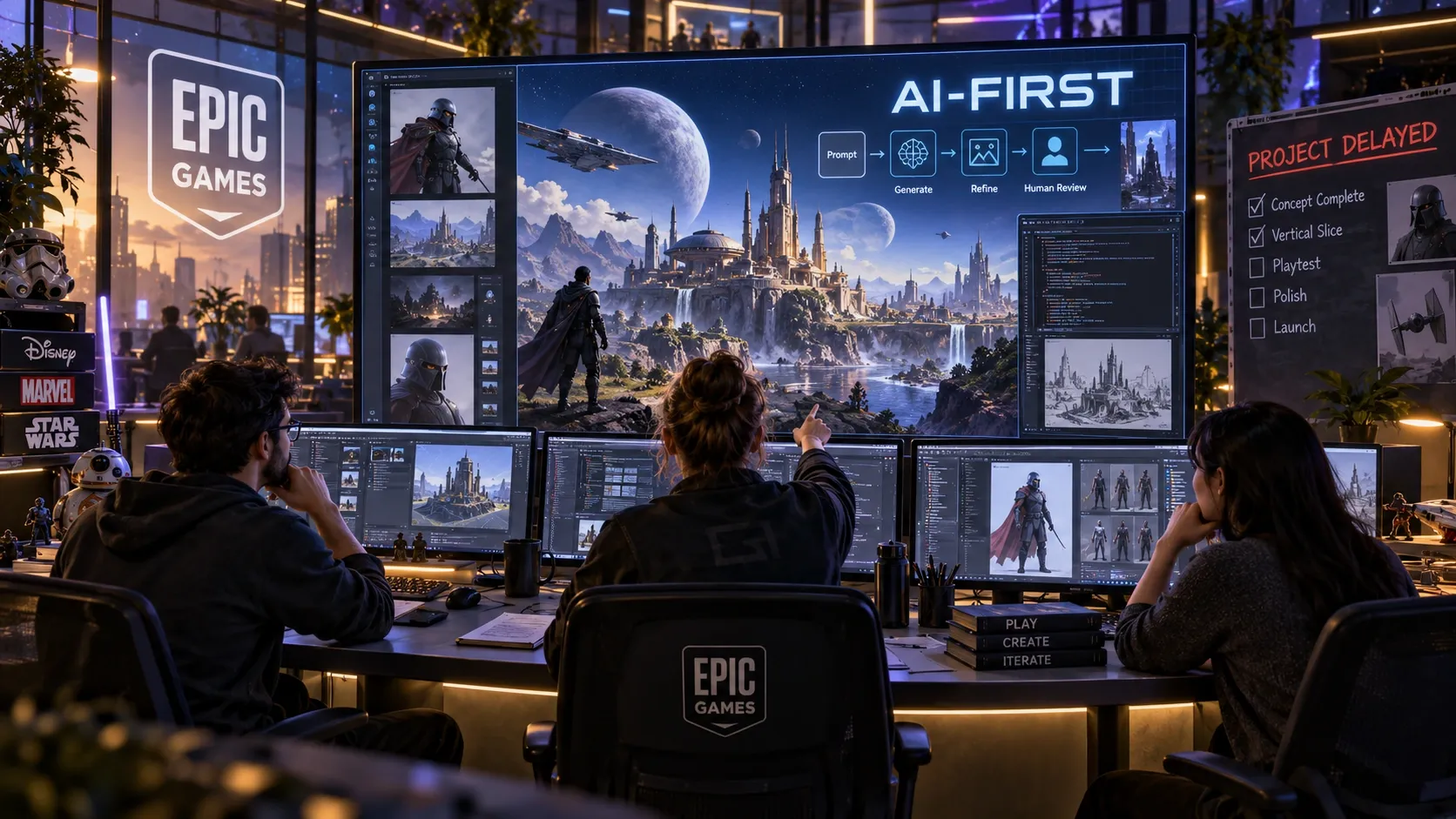
An unannounced shooter featuring Marvel and Star Wars characters, previously slated for a March 2027 release, has been delayed with no new release date [1]latimes.comEpic delays Disney game, tells developers to build it with AIEpic Games Inc. delayed the release of an upcoming video-game collaboration with Walt Disney Co. and told its developers to use more artificial intelligence tools to finish the game... Developers on the game, a shooter featuring…Open source ↗. The directive was stark: "No more hand-written code" [2]kotaku.comEpic Games Forces Shocked Developers Into 'AI-First' Mode For Delayed Shooter Featuring Marvel And Star Wars CharactersAccording to a new report by Bloomberg, developers on the game were told to implement an 'AI-first' production model using Anthropic’s Claude AI models. The team is not to use any more 'hand-written code,' and even artists are being…Open source ↗. This was not an incremental update but a fundamental restructuring of the studio’s core workflow, mandating an "AI-first" production model where Anthropic’s Claude would generate assets and code, with human developers relegated to roles of review and refinement [7]cryptobriefing.comEpic Games tells Disney shooter developers to build with AI firstEpic is reportedly shifting its delayed Disney extraction shooter to an AI-first production model.Open source ↗.
Epic Games CEO Tim Sweeney publicly described the change [4]msn.comEpic Games undergoes huge pivot for maximum AI acceleration amid reports of Disney shooter delay"The aim isn't to do the same stuff with fewer people," says Tim Sweeney... regarding Epic's massive AI pivot.Open source ↗. He said, "We have a huge pivot underway here at Epic," with developers being moved around to retool for maximum AI acceleration [4]. The stated aim was not to do the same work with fewer people, but to enable everyone to build more and better content, extending those benefits to all teams using Unreal Engine [6]invenglobal.comEpic Delays Disney Shooter Amid Shift to AI-First Model: 'No More Hand-Written Code'Epic Games has delayed a new shooter in development with Disney and introduced an 'AI-first' model for its development.Open source ↗. Sweeney argued that the significant reduction in time between having an idea and playtesting it was the key benefit of AI acceleration, potentially mitigating the issues that lead to AAA game failures [6]. His more modest aim was to "survive the AI revolution, help other developers do the same, and create better code and content faster" [6]. Epic communications director Jake Jones said the company is "embracing AI-accelerated development, led by Epic developers who are the visionaries and creative drivers for everything we do" [8]keengamer.comEpic Games Pushes For More AI in a Disney Shooter Involving Star Wars and Marvel CharactersEpic Games’ communication director, Jake Jones, said: 'We’re embracing AI-accelerated development, led by Epic developers who are the visionaries and creative drivers for everything we do.'Open source ↗.
The game has been delayed with no new release date. Progress on the Disney collaboration had been slower than expected because Epic underestimated the staffing levels and time required to complete the game [3]games.mxdwn.comEpic Games Delays Disney Shooter as Developers Are Told to Go “AI First”Epic Games has delayed an upcoming shooter featuring Marvel and Star Wars characters while reportedly directing developers to implement an AI-first workflow.Open source ↗. While Epic has confirmed its broader embrace of AI-accelerated development, the specific instructions for this game have not been announced in a public production plan [3]. The directive extends beyond programming to visual assets, with the game’s director reportedly stating that all art would be "generated with full AI workflows" [2]. This comprehensive mandate suggests a fundamental restructuring of the development pipeline rather than a simple augmentation of existing tools [1].
Compass Predictive Analytics
Compass Predictive Analytics

Developer Response and Internal Resistance
Developer response has been mixed, with significant reports of confusion and skepticism. Many working on the Disney game responded to the surprise AI policies with shock [2]. Some developers joked about how they should handle errors produced by AI-generated work, asking if they should ask Claude to fix its own mistakes [1]. Others expressed doubt about the feasibility of the initiative, hoping that the company would reverse course [2]. These sentiments reflect a broader industry anxiety about the role of generative AI in creative processes. A survey earlier this year found that more than half of game developers think generative AI is bad for the industry [1].
The stakes are heightened by Disney’s involvement. In 2024, Disney invested $1.5 billion in Epic Games in exchange for an equity stake and agreed to a multi-game partnership [3]. The investment was intended to kick off a broader collaboration involving Disney, Pixar, Marvel, Star Wars, and Avatar properties [7]. The delay of the first major title in this partnership raises questions about the viability of the timeline for the entire initiative. A spokesperson for Disney did not immediately respond to a request for comment [1]. Whether Disney has validated the quality and appropriateness of AI-generated content for its brands remains unresolved [5].
Intellectual property rights and brand consistency present unique challenges for AI-generated assets. Marvel and Star Wars franchises are tightly controlled, with established creative expectations that must be met for any licensed product [5]. Maintaining visual consistency across a full game is significantly harder than generating individual assets, and enforcing character standards requires rigorous oversight [5]. The intellectual property questions compound the operational ones, as the legal status of AI-generated art built on licensed characters remains contested across the industry [5]. Quality assurance processes must be rigorous enough to catch what the model gets wrong before it reaches players, yet Epic has described its philosophy without publicly showing the safety net or review gates necessary to protect the output [5].
Epic is not alone in exploring AI integration. Krafton declared a transition to an AI-first company last year, and Square Enix has set targets to automate QA tasks using generative AI [6]. However, Epic’s approach on the Disney shooter appears more radical. It is reportedly the first time a major video-game company has attempted to build a title primarily with AI rather than using it as a supplementary tool [1]. This distinction highlights the experimental nature of Epic’s current strategy and the risks involved in applying unproven workflows to unforgiving intellectual property [5]. The use of generative AI in games has been controversial among developers and gamers, who have loudly criticized games featuring AI-generated content as being of lesser quality [1]latimes.comEpic delays Disney game, tells developers to build it with AIEpic Games Inc. delayed the release of an upcoming video-game collaboration with Walt Disney Co. and told its developers to use more artificial intelligence tools to finish the game... Developers on the game, a shooter featuring…Open source ↗.
The pivot to an "AI first" model represents a high-stakes gamble for Epic Games. The delay of the project indicates that the transition is not seamless, and the internal resistance among developers highlights cultural hurdles that technology alone cannot resolve [2]. The risk to Epic is substantial. By applying an unproven workflow to a high-profile licensed title, the company is stress-testing its AI strategy on unforgiving intellectual property [5]. The lack of clarity regarding quality assurance, error correction, and Disney’s approval creates uncertainty about the project’s eventual success [5].
The timing of this pivot amidst layoffs and financial pressures raises questions about its sustainability. In March 2026, Epic laid off 1,000 employees due to slower sales of Fortnite and costs associated with antitrust litigation [3]. While Epic attributed these cuts to declining engagement and financial pressures, explicitly stating they were unrelated to AI, the reduction in headcount likely contributed to the understaffed teams mentioned in reports regarding the Disney shooter [3]. The combination of reduced staff and a mandate to adopt unproven technology has created a high-pressure environment for the remaining developers [1]. The industry’s skepticism toward generative AI remains strong, and Epic’s aggressive stance may alienate both developers and players who value human creativity [3].
In conclusion, Epic’s "AI first" pivot is a bold but risky strategic move. It demonstrates a willingness to disrupt traditional development models, but the current evidence suggests that the benefits of acceleration are not yet outweighing the costs of complexity and resistance [5]. The success of this initiative will depend on whether Epic can demonstrate tangible improvements in quality and efficiency without compromising the integrity of its licensed properties [5]. Until new release dates or successful milestones are announced, the pivot remains an ambitious experiment with unresolved outcomes [3]. The industry will watch closely to see if AI can truly accelerate development without eroding the creative standards that define iconic franchises [1].
Compass Predictive Analytics

Strategic Intent and Leadership Vision
Tim Sweeney has said the aim of Epic's AI push is not to do the same work with fewer people, but to enable everyone at Epic to build more and better content [4]. He said Epic is "moving developers around to retool for maximum AI acceleration" [4]. This vision extends beyond the Disney project; Sweeney explicitly stated that the benefits of this acceleration should eventually reach all teams utilizing Unreal Engine, suggesting a platform-wide transformation rather than an isolated experimental pipeline [6]. The goal is to compress the feedback loop between conceptualization and playtesting, a metric Sweeney identifies as critical for avoiding the pitfalls that have plagued recent AAA releases [6]. By reducing the time required to iterate on game systems, Epic aims to foster a development culture where ideas can be validated more rapidly, theoretically leading to higher quality outputs through increased experimentation.
However, this strategic intent clashes with the operational realities of licensed intellectual property. Disney’s $1.5 billion investment was predicated on a multi-year collaboration that includes not just games, but a broader entertainment universe involving Pixar, Marvel, and Star Wars [7]. The delay of the inaugural title in this partnership casts a shadow over the entire initiative. Sweeney’s more modest aim is to "survive the AI revolution," and the game could become a significant test of how far generative AI can be integrated into a large-scale, franchise-driven release [6]. This gamble carries significant reputational risk. If the AI-generated content fails to meet the stringent quality and consistency standards associated with Disney brands, the damage could extend beyond the single game to affect investor confidence in the broader partnership.
The leadership’s stance also reveals a tension between internal efficiency goals and external brand protection. Sweeney has previously criticized platforms like Steam for forcing developers to disclose AI usage, arguing that such requirements hinder innovation [4]. Disney did not immediately respond to a request for comment on the project [1].
Furthermore, the strategic intent appears to be influenced by Epic’s broader market position. Epic laid off more than 1,000 employees in March 2026, citing declining Fortnite engagement and financial pressures, and stated that the layoffs were not related to AI [3]. Sweeney has said the aim is not to do the same work with fewer people, but to enable everyone at Epic to build "MORE and BETTER stuff" [4]msn.comEpic Games undergoes huge pivot for maximum AI acceleration amid reports of Disney shooter delay"The aim isn't to do the same stuff with fewer people," says Tim Sweeney... regarding Epic's massive AI pivot.Open source ↗.
Compass Predictive Analytics
Intellectual Property and Quality Assurance Challenges
These franchises are among the most tightly controlled in entertainment, with established creative expectations that must be strictly adhered to for any licensed product [5]. Maintaining visual consistency across a full game is significantly harder than generating individual assets [5]. Enforcing these standards requires rigorous oversight, and under the described approach human developers would guide and manage the AI-generated work [3]games.mxdwn.comEpic Games Delays Disney Shooter as Developers Are Told to Go “AI First”Epic Games has delayed an upcoming shooter featuring Marvel and Star Wars characters while reportedly directing developers to implement an AI-first workflow.Open source ↗.
The intellectual property questions compound the operational ones. The legal status of AI-generated art built on licensed characters remains contested across the industry, with unresolved issues regarding copyright ownership and licensing rights [5]. How contractual obligations to Disney get satisfied when the tool generating the assets is a language model trained on data whose licensing status remains contested is an open question [5]. Epic has described its philosophy of AI-accelerated development without publicly addressing these copyright nuances, leaving stakeholders uncertain about how the company plans to navigate these legal complexities [5]. The lack of clarity regarding player disclosure about production methods further exacerbates these concerns, as fans have been vocal about their expectations for transparency in game development.
Quality assurance processes must be rigorous enough to catch what the model gets wrong before it reaches players, yet Epic has described its philosophy without publicly showing the safety net or review gates necessary to protect the output [5]. The directive to use "no more hand-written code" implies a shift in the role of human developers from creators to validators. The available reporting does not establish whether the new workflow will shorten development or create additional production challenges related to error correction [3]. Developers have expressed concerns about how mistakes in AI-generated work would be identified and corrected, particularly given the high stakes of maintaining brand integrity for Marvel and Star Wars [1].
The absence of public Disney approval for the revised AI workflow is a critical gap in this narrative. Disney did not immediately respond to a request for comment on the project [1]latimes.comEpic delays Disney game, tells developers to build it with AIEpic Games Inc. delayed the release of an upcoming video-game collaboration with Walt Disney Co. and told its developers to use more artificial intelligence tools to finish the game... Developers on the game, a shooter featuring…Open source ↗.
Compass Predictive Analytics
Strategic Judgment
The pivot to an "AI first" model represents a high-stakes gamble for Epic Games. The delay of the project indicates that the transition is not seamless, and the internal resistance among developers highlights cultural hurdles that technology alone cannot resolve [2]. The risk to Epic is substantial. By applying an unproven workflow to a high-profile licensed title, the company is stress-testing its AI strategy on unforgiving intellectual property [5]. The lack of clarity regarding quality assurance, error correction, and Disney’s approval creates uncertainty about the project’s eventual success [5].
The timing of this pivot amidst layoffs and financial pressures raises questions about its sustainability. In March 2026, Epic laid off 1,000 employees due to slower sales of Fortnite and costs associated with antitrust litigation [3]. While Epic attributed these cuts to declining engagement and financial pressures, explicitly stating they were unrelated to AI, the reduction in headcount likely contributed to the understaffed teams mentioned in reports regarding the Disney shooter [3]. The combination of reduced staff and a mandate to adopt unproven technology has created a high-pressure environment for the remaining developers [1]. The industry’s skepticism toward generative AI remains strong, and Epic’s aggressive stance may alienate both developers and players who value human creativity [3].
In conclusion, Epic’s "AI first" pivot is a bold but risky strategic move. It demonstrates a willingness to disrupt traditional development models, but the current evidence suggests that the benefits of acceleration are not yet outweighing the costs of complexity and resistance [5]. The success of this initiative will depend on whether Epic can demonstrate tangible improvements in quality and efficiency without compromising the integrity of its licensed properties [5]. Until new release dates or successful milestones are announced, the pivot remains an ambitious experiment with unresolved outcomes [3]. The industry will watch closely to see if AI can truly accelerate development without eroding the creative standards that define iconic franchises [1].
Compass Predictive Analytics