
Listen to this article
Narrated by Charlotte · The Noble House

The opening keynote delivered by Dr. Lisa Su at the 2026 Open Compute Project (OCP) Global Summit in San Jose marked a definitive pivot for AMD’s data center strategy, shifting focus from static AI workloads to the dynamic demands of agentic systems [1]newsroom.amd.comOCP 2026: AMD CEO Highlights Open Infrastructure for AIDuring the opening keynote at the 2026 OCP Global Summit, Dr. Lisa Su, chair and CEO at AMD, showed how the company's portfolio of open, full-stack infrastructure delivers the computing power to support agentic AI at every scale... The…Open source ↗ [8]thebuildout.aiAMD CEO Lisa Su to discuss open innovation and data center infrastructure at OCP Global Summit 2026AMD Chair and CEO Lisa Su will deliver a keynote at the 2026 OCP Global Summit to discuss the role of open innovation and industry-wide collaboration in advancing AI infrastructure.Open source ↗. This transition requires a fundamental reconfiguration of hardware architecture, moving beyond isolated accelerator racks toward integrated, rack-scale ecosystems that balance central processing unit (CPU) density with GPU acceleration. AMD’s announcements regarding the Helion reference design and the next-generation EPYC Verano processor illustrate a coordinated effort to capture market share in agentic AI infrastructure by leveraging open standards to reduce vendor lock-in and address the specific computational demands of autonomous agents.
The Helion Reference Design and Agentic Workload Requirements
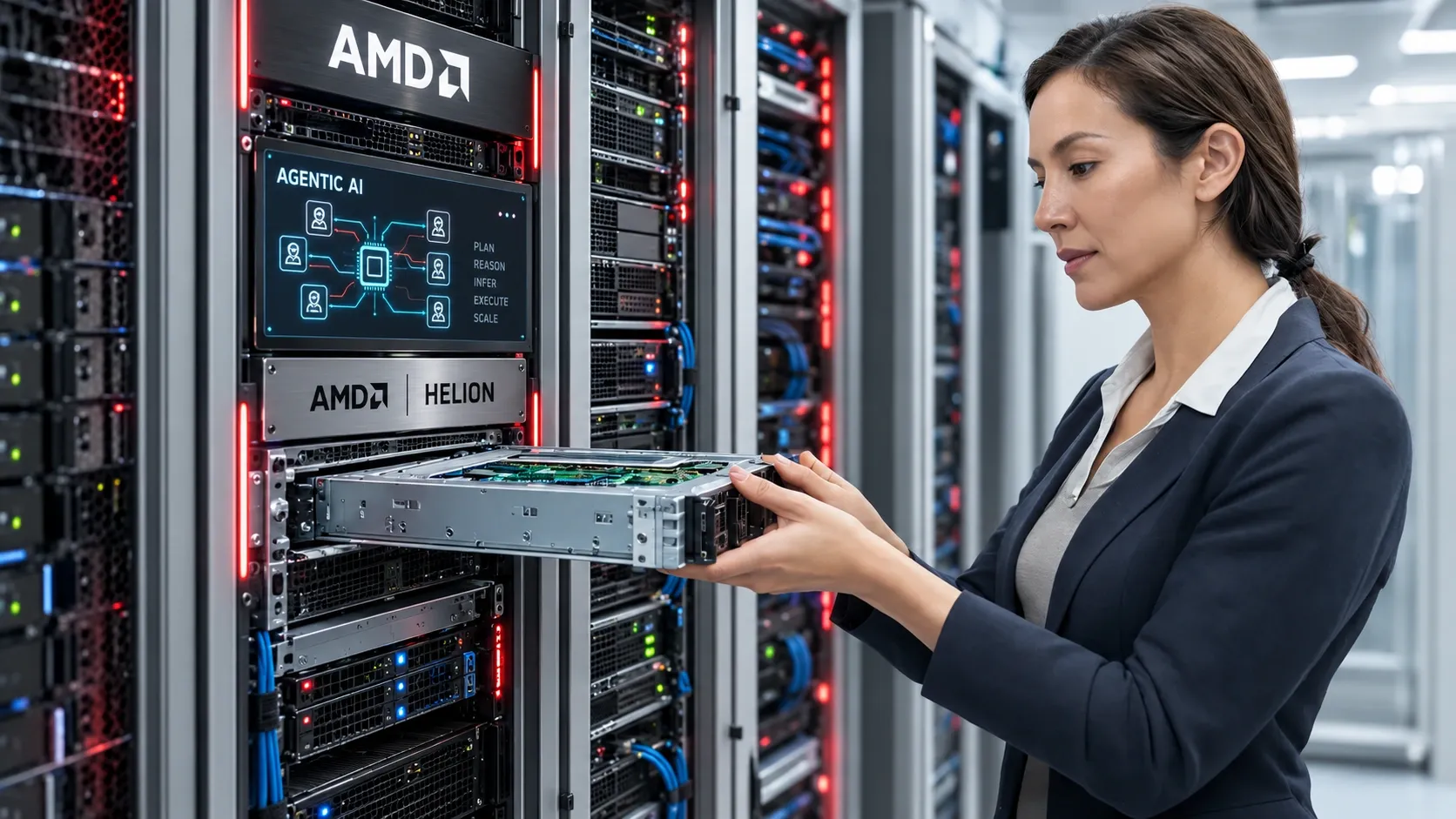
AMD introduced the Helion rack-scale reference design as a specialized solution for agentic AI, a category of systems that plan tasks, invoke tools, and execute code rather than merely responding to prompts. This architectural distinction necessitates a different hardware balance compared to traditional large language model training or inference racks. The Helion design is built on Open Compute Project specifications, specifically aligning with the ORv4 standard for interoperability between key elements of data center infrastructure [6]msn.comAMD debuts Helion reference design for agentic AI servers with up to 32,768 Zen 6 'Venice' coresAt the OCP Global Summit, AMD revealed Helion, a rack-scale reference design for agentic AI that can house up to 32,768 Zen 6 'Venice' cores... The new design allows for flexible CPU-only or mixed CPU/GPU configurations.Open source ↗. Depending on the configuration, the design supports up to 32,768 Zen 6 CPU cores in a CPU-only deployment, utilizing dense 256-core versions of the EPYC Venice processor. This high core density is critical for hyperscale operators who deploy separate CPU racks alongside distinct GPU inference systems to handle agent execution and orchestration tasks [10]networkworld.comAMD unveils Helion as agentic AI fuels demand for data center CPUsAMD has introduced Helion, an open blueprint for data center racks that aims to give CPUs a larger role in running AI agents while allowing customers to configure GPU resources around their inference requirements... The growing use of AI…Open source ↗.
For enterprise environments, AMD offered a mixed configuration that integrates CPUs with up to 16 Instinct MI350P GPUs within a single rack. This all-in-one approach aims to simplify data management and networking for organizations that require both agent execution and local inference capabilities. The design supports up to 102 Tbps of networking bandwidth, a specification that represents planned rack capability rather than demonstrated performance in customer environments [9]cryptobriefing.comAMD launches Helion open rack blueprint for agentic AI workloadsThe chipmaker's new rack-scale design leans on CPUs, open standards and a built-in token router to take on Nvidia's GPU-heavy systems... Helion supports up to 102 Tbps of networking bandwidth... AMD also plans to share Helion's…Open source ↗. A notable feature of the Helion architecture is its integrated token router, which directs model requests across frontier, cloud-hosted, and open-source models. This functionality allows data center operators to optimize costs by matching specific agent tasks with the most appropriate computational resources, whether those are high-end accelerators or general-purpose cores [2]theregister.comAMD unveils Helion racks for AI agents at OCP summitRevealed at the Open Compute Project (OCP) Summit 2026 in San Jose, California, the chipmaker's new rack reference design is named Helion... Helion offers an OCP-compliant blueprint for agentic AI infrastructure built around AMD's CPUs…Open source ↗.
The strategic intent behind Helion is clearly defined as a response to the growing demand for CPU-intensive agentic workloads. Industry analysts note that the AI industry is expecting a significant adjustment in the ratio of accelerators to CPUs, potentially moving from 16:1 toward parity. By providing an open blueprint that ecosystem partners such as Cisco, Dell Technologies, HPE, Lenovo, and Supermicro can adopt, AMD aims to lower the switching costs for customers wary of proprietary vendor ecosystems [9]. Partner-built Helion configurations are scheduled for shipment in November 2026, positioning the company to capitalize on early adoption by hyperscalers and enterprises alike [2].
Compass Predictive Analytics
Verano Processor Architecture and Memory Innovation
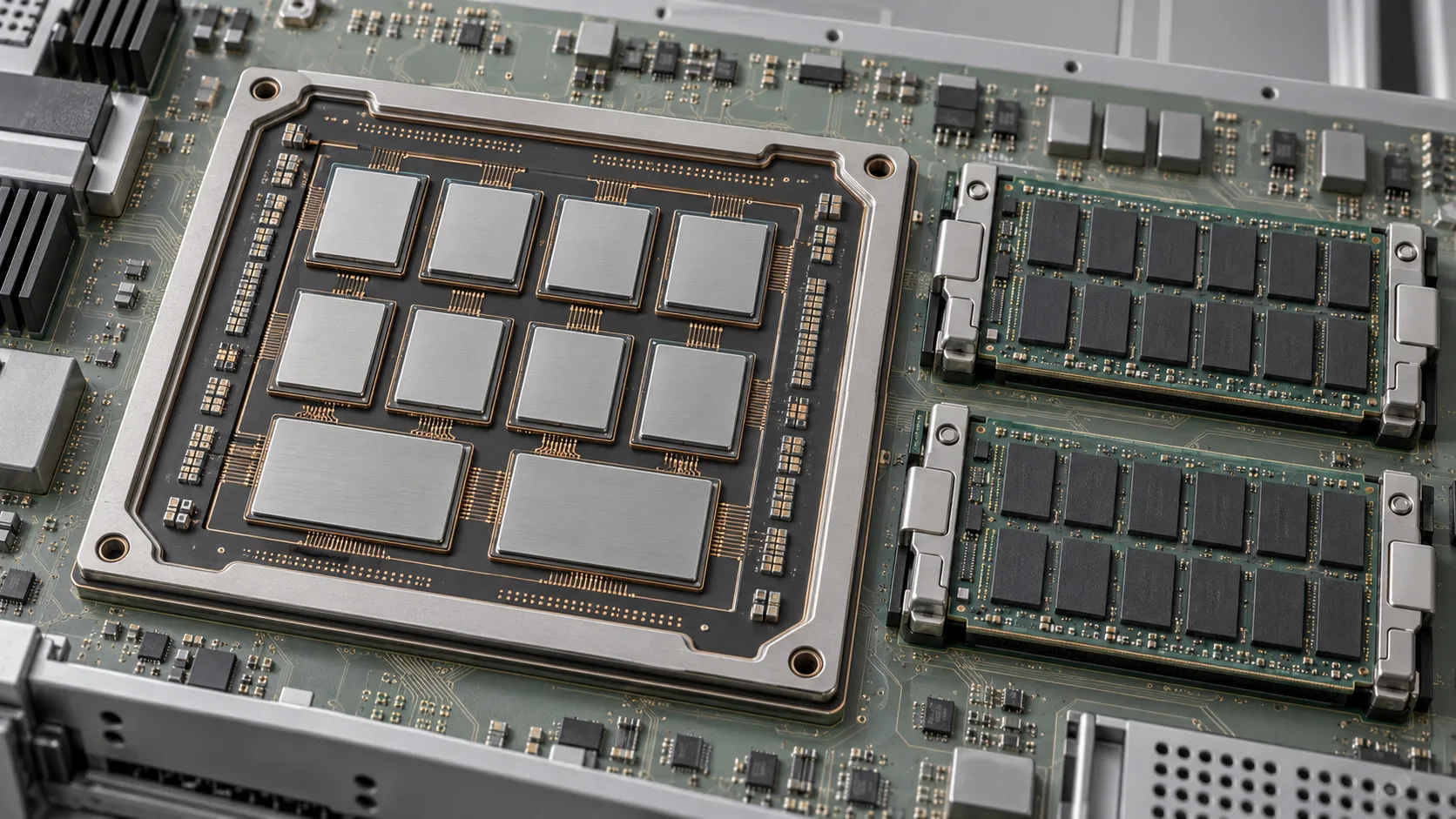
Alongside the infrastructure announcements, AMD showcased the sixth-generation EPYC server processor codenamed Verano during the keynote [7]convergedigest.comLisa Su said during her October 12 keynote at the OCP Global Summit in San JoseLisa Su highlighted the transition from static AI workloads to dynamic agentic systems during her keynote. She noted that Helios is shipping now, while Verano is targeted for 2027.Open source ↗. Built on the Zen 6 microarchitecture and manufactured using the TSMC 2 nm process, Verano represents a significant evolution in silicon design optimized for agentic AI racks. The processor supports up to 192 cores per chip, a substantial increase from earlier projections of 72 cores. This high core count is achieved through a configuration of eight Zen 6 compute complex dies alongside two large input/output dies and four LPDDR5X memory controllers [3]techpowerup.comAMD Showcases Its Next-Gen EPYC "Verano" CPU, Up to 192 Cores and LPDDR5X MemoryAMD showed off its next-generation EPYC 'Verano' server CPUs during CEO Dr. Lisa Su opening keynote at the 2026 OCP Global Summit. The new CPU is the first EPYC processor to support LPDDR5X memory via SOCAMM2 modules... Verano is…Open source ↗.
A critical innovation in the Verano design is its support for LPDDR5X memory via SOCAMM2 modules, marking the first time an EPYC processor has adopted this memory standard [3]. This shift away from traditional DDR memory signals a strategic move toward higher bandwidth density, which is essential for AI workloads that require rapid data access across numerous cores. The Verano processor is designed to operate on the new SP8 platform rather than the SP7 platform used by its predecessor, Venice. It pairs with AMD’s Instinct MI500 GPUs via xGMI connectivity at speeds up to 112 Gbps, ensuring low-latency communication between the CPU and accelerator components within agentic systems [3].
Availability for Verano is targeted for 2027, allowing time for ecosystem partners to adapt their server designs to the new socket and memory specifications. The processor’s emphasis on low system power and high core density aligns with the broader industry trend toward optimizing energy efficiency in dense AI deployments. By introducing Verano alongside Helion, AMD presents a cohesive hardware roadmap where the silicon is specifically engineered to maximize the performance of the open rack architecture [7].
Compass Predictive Analytics
Market Dynamics: The Inference Boom and CPU Resurgence
Dr. Lisa Su projected a massive shift in the data center AI market, driven by the transition from training-focused workloads to inference [5]finance.yahoo.comAMD CEO Lisa Su Sees AI Inference Boom Fueling $1.5T Demand By 2030Advanced Micro Devices (AMD) CEO Lisa Su sees AI inference driving the next wave of growth, with the data center AI market projected to reach $1.5 trillion by 2030... About 60% of the market going forward will be driven by inference…Open source ↗. She forecasted that data center AI market demand will reach $1.5 trillion by 2030, with approximately 60% of this future growth driven by inference workloads rather than training [5]. This assertion underscores the economic importance of agentic AI, which relies heavily on continuous, low-latency inference to execute autonomous tasks. The sustained demand for inference is creating a renewed relevance for CPUs, which handle the orchestration, code execution, and workflow management that accompany model outputs [4]datacenterfrontier.comOCP 2026: Agentic AI Drives the Data Center's Chip-to-Grid TransformationAt the Open Compute Project Global Summit, AMD, Meta, Arm, Broadcom and NVIDIA outlined a sweeping transformation of AI infrastructure... AMD introduced its Helion agentic AI rack... OCP is extending its standards mission from servers and…Open source ↗.
AMD has revised its estimated total addressable market for data center CPUs multiple times in recent months, now forecasting a market exceeding $200 billion by 2030 with annual growth approaching 50%. This aggressive projection reflects the company’s belief that agentic computing is altering expectations for data center hardware demand [5]. The integration of Helion and Verano positions AMD to capture this growth by offering infrastructure that balances CPU and GPU resources according to specific workload needs. Analysts suggest that separating agent execution from GPU inference allows data center operators to scale resources independently, potentially improving accelerator utilization and reducing total cost of ownership [10].
The keynote also highlighted the operational status of AMD’s existing Helios rack-scale system, which is currently shipping to major customers including Meta, Microsoft, OpenAI, Oracle, and Anthropic. Helios remains focused on large-scale model training and inference, utilizing a tightly integrated 72-GPU design. In contrast, Helion addresses the distinct requirements of agentic AI, providing flexibility for CPU-dense deployments. This dual-track approach allows AMD to serve both the current hyperscale training market and the emerging agentic infrastructure demand simultaneously [5].
Compass Predictive Analytics

Open Infrastructure Strategy and Industry Collaboration
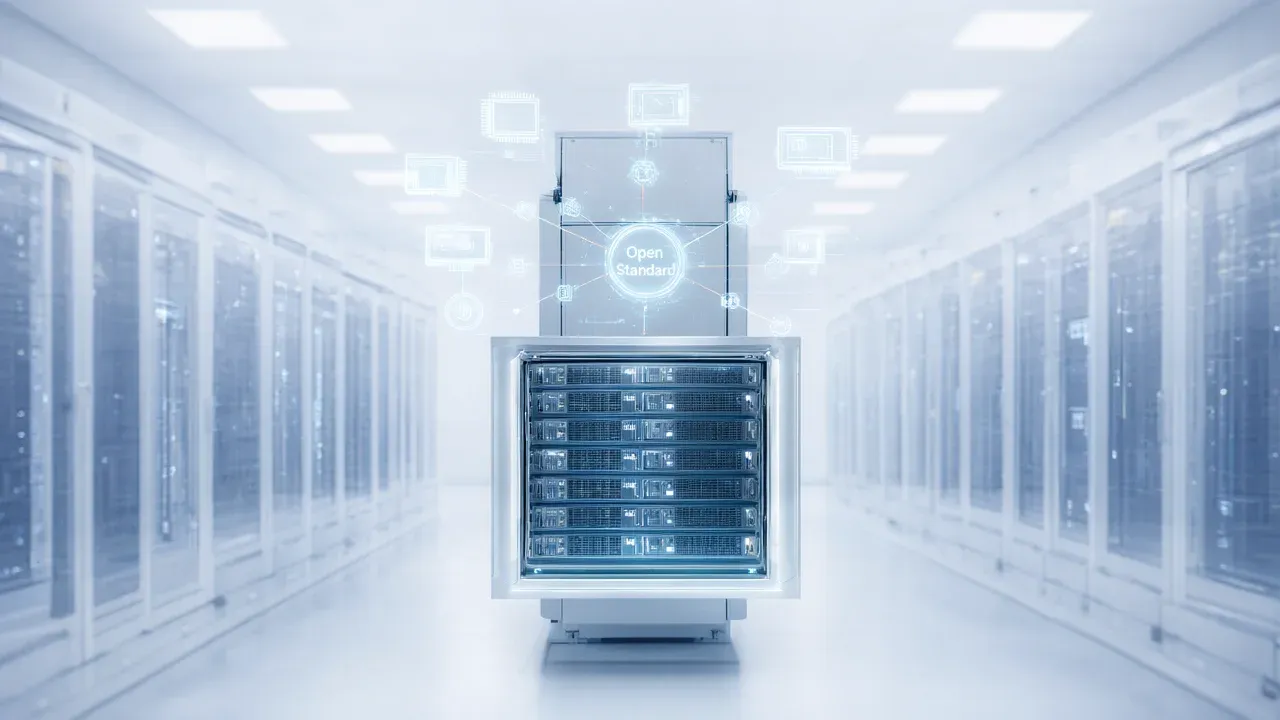
The overarching theme of the keynote was the critical role of open standards in shaping the future of AI infrastructure. OCP is expanding its mission beyond individual servers and racks to encompass the full AI infrastructure stack, including silicon, cooling, power distribution, facilities, and utility-grid integration [4]. This expansion reflects a growing recognition that the physical constraints of data centers are becoming as significant as computational limitations. The industry is moving toward co-optimized data centers where silicon, networking, cooling, and power systems are developed with common interfaces and shared design objectives.
AMD’s commitment to contributing the Helion specifications to OCP aligns with this broader industry shift. By adopting open standards such as Open Rack Wide and DC-MHS, AMD aims to facilitate interoperability across heterogeneous hardware ecosystems. This strategy reduces the engineering burden on customers who must otherwise redesign infrastructure every time underlying computing technology changes. The keynote coverage highlighted that AMD, alongside peers like Meta, Arm, Broadcom, and NVIDIA, is outlining a sweeping transformation of AI infrastructure through open standards [4].
The emphasis on collaboration extends to software as well. AMD highlighted its ROCm software ecosystem and Hyperloom agentic optimization system as tools for improving application performance after hardware deployment. The company’s strategy relies on the premise that no single entity can solve every aspect of AI infrastructure alone. By fostering an open ecosystem, AMD seeks to accelerate adoption of its full-stack solutions while maintaining flexibility for customers to integrate components from multiple vendors. This approach is particularly relevant in a market where hyperscalers are developing custom accelerators alongside commercial GPUs and CPUs, increasing the risk of fragmented hardware ecosystems [4].
Compass Predictive Analytics
Strategic Judgment on AMD’s Positioning
The announcements at OCP 2026 indicate that AMD is positioning itself as a critical enabler of agentic AI infrastructure through open standards rather than attempting to compete solely on proprietary accelerator performance. The Helion design and Verano processor represent a coherent response to the specific computational demands of autonomous agents, which require high CPU density and flexible memory bandwidth. By offering an open blueprint that partners can adopt, AMD aims to reduce vendor lock-in and appeal to customers seeking cost flexibility and integration with existing IT environments [9].
The forecasted $1.5 trillion market size and the projected dominance of inference workloads provide a strong economic tailwind for AMD’s strategy. However, success will depend on the ability of ecosystem partners to deliver validated designs and on AMD’s capacity to demonstrate competitive performance and software maturity. The integration of LPDDR5X memory in Verano and the high core count of the processor suggest a technical advantage in bandwidth-intensive agentic tasks. Yet, the challenge of network latency between separated CPU and GPU systems remains a critical factor for overall system efficiency [4].
AMD’s strategy is decisive in its focus on open infrastructure as a differentiator. While competitors continue to push proprietary integrated solutions, AMD’s approach offers customers choice and adaptability in an evolving market. The company’s positioning suggests that it views the future of AI not as a battle for single-component supremacy, but as a contest for the most efficient and flexible full-stack ecosystem. If the industry continues to converge on chip-to-grid interoperability standards, AMD’s early commitment to open rack designs and its comprehensive silicon roadmap position it strongly to capture significant share in the next generation of data center infrastructure [4]. The transition to agentic AI represents a structural transformation of the data center, and AMD’s announcements at OCP 2026 signal a clear intent to lead that transformation through open collaboration and specialized hardware design.