
Listen to this article
Narrated by Charlotte · The Noble House

Legal Framework and Tribunal Procedures
The sovereignty dispute over the Falkland Islands has shifted from diplomatic rhetoric to international legal arbitration, driven by the commercial development of the Sea Lion oil field. On October 13, 2026, the Argentine government filed a request for provisional measures with the International Tribunal for the Law of the Sea (ITLOS) in Hamburg, seeking to halt the $2.2 billion project operated by Navitas Petroleum and Rockhopper Exploration [1]apnews.comArgentina seeks international tribunal order to halt UK oil project in FalklandsArgentina said Tuesday it had asked an international maritime tribunal to halt oil development off the disputed Falkland Islands, escalating a row with Britain over sovereignty and resources.Open source ↗[6]sfgate.comArgentina takes fight with UK over Falklands' oil industry to international tribunalThe office of President Javier Milei said it had filed a request for provisional measures with the International Tribunal for the Law of the Sea in Hamburg, Germany, seeking to stop the development of Sea Lion, a $2.2-billion…Open source ↗. This legal challenge underscores the economic stakes of the conflict, highlighting that the tribunal cannot enforce its own orders [4]easternherald.comArgentina Asks Hamburg Court to Halt Falklands Sea Lion Oil ProjectThe court cannot enforce its orders, but the legal move puts diplomatic pressure on London and highlights the economic stakes of the sovereignty dispute.Open source ↗.
Argentina’s strategy relies on Article 290 of the UN Convention on the Law of the Sea (UNCLOS), which allows parties to request provisional measures while an arbitral panel is constituted [4][8]batimes.com.arArgentina asks Law of the Sea tribunal to halt Malvinas oil projectMilei government seeks provisional measures against Sea Lion development off the coast of islands, escalating a long-running dispute with economic implications for both nations.Open source ↗. The filing follows arbitration proceedings initiated by Buenos Aires on September 28 under Annex VII of UNCLOS, aiming to preserve sovereign rights over the continental shelf before a final ruling is issued [5]buenosairesherald.comArgentina asks UN court to halt Malvinas oil drillingThe request filed with ITLOS 'seeks to preserve the Argentine sovereign rights over its continental platform and prevent activities unilaterally and illegally authorized by the United Kingdom.'Open source ↗[8]. Argentina seeks four orders: that the UK prevent the start or continuation of Sea Lion development, that it not use data gathered in the disputed waters against Argentine rights, that it stop preventing Argentina from protecting the marine environment there, and that it refrain from steps that could aggravate the dispute, in particular new permits on the disputed shelf [3]msn.comArgentina lodges legal claim against UK's Falklands oil explorationArgentina asked the International Tribunal for the Law of the Sea on Tuesday to order Britain to halt the Sea Lion oil project, marking a new phase in the decades-old dispute.Open source ↗[4]. ITLOS, an independent judicial body established under UNCLOS, can issue binding emergency orders if it deems the situation urgent, but it lacks any enforcement mechanism to compel compliance from a refusing state [1][7]aljazeera.comArgentina’s Milei threatens legal action over Falklands oil projectArgentina's government under President Milei has previously threatened legal action over the Falklands oil project, setting the stage for the current ITLOS filing.Open source ↗. Consequently, the tribunal’s role is limited to preserving rights during arbitration rather than settling the underlying sovereignty question, which remains a political matter between Argentina and the UK [8].
The procedural mechanics of this legal maneuver are precise. Argentina’s application asks judges to order the United Kingdom to prevent the start or continuation of the Sea Lion development in what Argentina calls the North Malvinas Basin [4]. The tribunal can act only if it finds that the future panel would prima facie have jurisdiction and that the situation is urgent [4]. A hearing date has not yet been set, though ITLOS stated one "will be announced shortly" [4]. This interim measure is distinct from the final arbitration case. Under the convention, parties are bound to comply with measures the tribunal prescribes, but the tribunal has no enforcement arm of its own [4].
Compass Predictive Analytics
Compass Predictive Analytics

Economic Stakes and Project Development
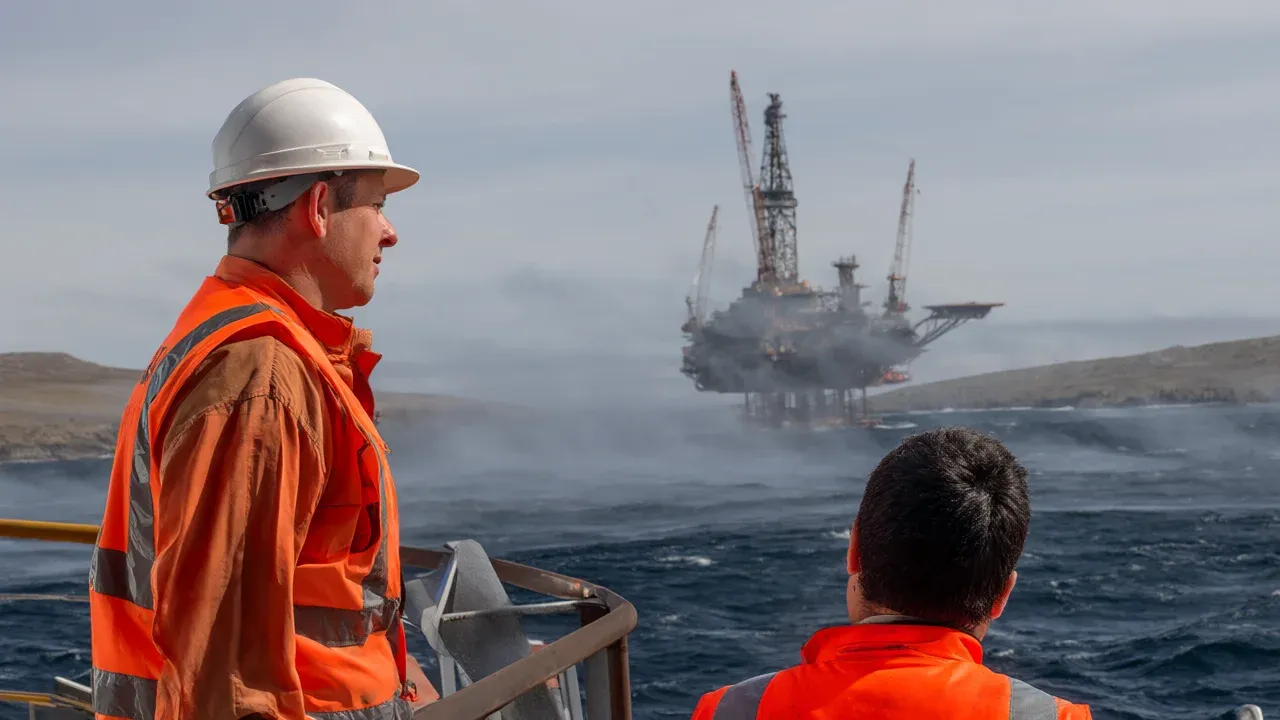
The Sea Lion oil field, located approximately 220 kilometers north of the Falkland Islands in the North Malvinas Basin, holds an estimated 1.7 billion barrels of oil [3][4]. Navitas Petroleum holds a 65 percent stake in the project, while Rockhopper Exploration owns the remaining 35 percent [8]. The companies assert they possess valid exploration licenses issued by the Falkland Islands government, which require sign-off by the UK Foreign Secretary [3]. Production is projected to begin in 2028, with initial output of up to 55,000 barrels per day rising to 125,000 barrels per day in later stages [1][8]. This potential revenue stream could transform the economy of the Falkland Islands, home to approximately 3,500 inhabitants who voted overwhelmingly to remain a British overseas territory in a 2013 referendum [4]. The UK government maintains that the field lies on the islands’ continental shelf and is regulated by their democratically elected government, rejecting Argentina’s jurisdiction [1][6].
The commercial implications of the dispute are already tangible. In an announcement relayed by Rockhopper Exploration on October 5, Navitas said Argentina “continues its activity to impose sanctions” on those involved in Sea Lion and that, after a media report on behalf of a contractor said it would not work on the project, it was taking action “to replace two breaching contractors” [4]. Navitas still expects “no material adverse effect,” but its own caveat is blunt: the assessment may not hold if the replacements are “delayed or unsuccessful” or if more contractors step back and no satisfactory alternatives are found [4]. The pressure Navitas describes comes from Argentina's sanctions campaign, which has already forced operational adjustments at the project [4].
The UK government views the legal challenge as an attempt at economic coercion and has introduced measures under the Protection of Trading Interests Act to protect firms from extra-territorial impacts of Argentine laws [3]. Foreign Secretary Ed Miliband described Argentina’s attempts to intimidate businesses as unacceptable, asserting that companies should be free to make lawful commercial decisions without political pressure [3]. The British government for its part has said it stands behind the businesses operating near the Falklands, with Navitas and Rockhopper insisting they have valid exploration licenses issued by the UK [7]. The dispute over the Falkland Islands led to a war between Britain and Argentina in 1982, which killed 649 Argentinian soldiers, 255 British soldiers and three islanders after Argentina invaded the archipelago that year [7].
Compass Predictive Analytics
Diplomatic Escalation and Political Context
The legal filing follows weeks of escalating rhetoric from President Javier Milei, who gave the UK a two-week ultimatum in September to halt work on Sea Lion or face legal action [7]. Milei has declared the operations "illegal plundering" and launched criminal charges against the executives and shareholders of the project [1][7]. Analysts suggest Milei is tapping into a cause with broad political support to shore up his popularity as the Argentine economy struggles ahead of next year’s presidential election [6].
The British-controlled Falklands are an enduring national obsession in Argentina, which calls them the Malvinas and maintains that Britain has illegally occupied them since 1833 [1]. London rejects that claim, citing the islanders’ desire to remain a British overseas territory [1]. The UN lists the Falkland Islands, which Argentina calls the Malvinas, as a non-self-governing territory and has long urged both sides to negotiate [4]. Talks have been tried before; Argentina’s call for talks on the Falklands was reported in 2023, but no sovereignty talks occur without islander consent, London holds [4]. In a 2013 referendum, 1,513 of 1,517 voters chose to remain British [4].
Washington is the unspoken variable. Donald Trump has said Washington is open to reviewing its historically neutral stance on the territory [7]aljazeera.comArgentina’s Milei threatens legal action over Falklands oil projectArgentina's government under President Milei has previously threatened legal action over the Falklands oil project, setting the stage for the current ITLOS filing.Open source ↗. Christoph Bluth, a professor at the University of Bradford, said the idea appeared to have originated “inside the Pentagon as leverage against Britain” rather than from any reassessment of the dispute itself [4]. UK officials believe the current Argentine leadership is deliberately picking a fight ahead of elections next year [3].
Compass Predictive Analytics

Analysis of Geopolitical Implications
The involvement of international legal bodies adds complexity to the sovereignty dispute, highlighting the economic stakes of the dispute [4]. Although the tribunal cannot enforce its orders, the legal move puts diplomatic pressure on London [4]easternherald.comArgentina Asks Hamburg Court to Halt Falklands Sea Lion Oil ProjectThe court cannot enforce its orders, but the legal move puts diplomatic pressure on London and highlights the economic stakes of the sovereignty dispute.Open source ↗. Navitas says Argentina’s sanctions campaign has already forced it to replace two contractors, a commercial pressure separate from the tribunal filing [4]. Washington has not endorsed Argentina’s claim; asked whether the US position was under review, President Donald Trump said, “I always review every position,” while Christoph Bluth of the University of Bradford suggests the idea appeared to have originated inside the Pentagon as leverage against Britain rather than from a reassessment of the dispute itself [4]. Britain’s defence secretary has called the UK commitment to the islands “unshakeable,” and UK officials believe the current Argentine leadership is deliberately picking a fight ahead of elections next year [4][3]. The resolution of this dispute remains uncertain: ITLOS is not being asked to rule on the underlying sovereignty question, and London holds that there can be no sovereignty talks without the islanders’ consent [8][4]easternherald.comArgentina Asks Hamburg Court to Halt Falklands Sea Lion Oil ProjectThe court cannot enforce its orders, but the legal move puts diplomatic pressure on London and highlights the economic stakes of the sovereignty dispute.Open source ↗.
EH reported on those Falklands oil sanctions when they were announced [4].
Washington is the unspoken variable. The claim is also fought in public: in July, a Falklands banner at the World Cup sparked a diplomatic row, EH reported [4].
The tribunal has not yet set a hearing date. The question the judges cannot settle is the one the companies are answering one contract at a time: who will still be working on Sea Lion when it does [4].
Compass Predictive Analytics