Listen to this article
Narrated by Charlotte · The Noble House

- Thesis: The Supreme Court’s oral arguments in Suncor Energy Inc. v. Commissioners of Boulder County
- Metaphor:
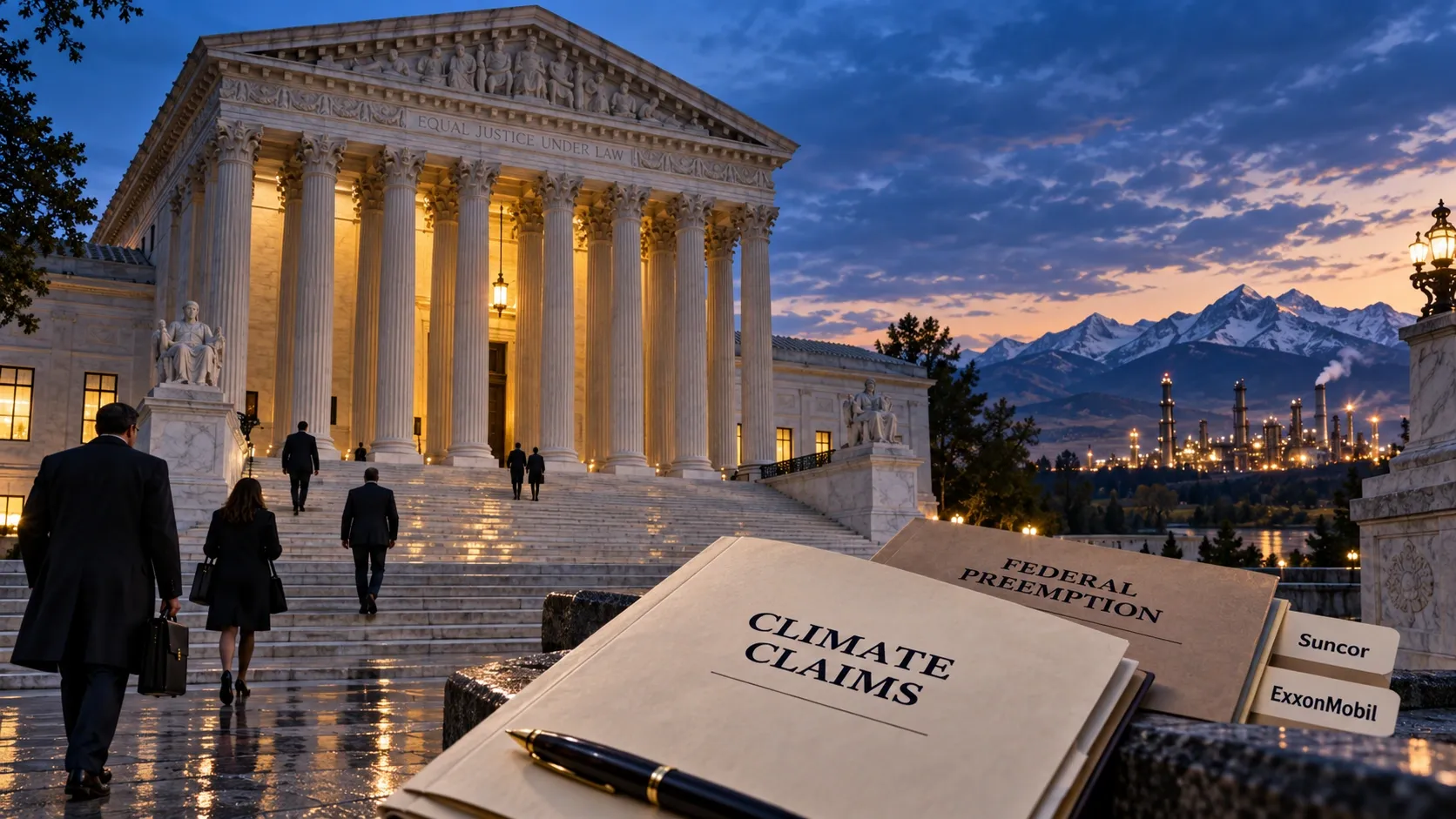
The Supreme Court opened its 2026-2027 term with oral arguments in Suncor Energy Inc. v. Commissioners of Boulder County, a case that tests the boundary between state tort law and federal environmental regulation [4]scotusblog.comCourt sends mixed signals on whether it will allow state-tort suits seeking to hold energy companies liable for climate change to go forwardThe Supreme Court on Monday opened its new term by hearing arguments in a lawsuit filed in state court by the city and county of Boulder, Colorado, seeking to hold two major energy companies accountable for the costs of local climate…Open source ↗. The lawsuit, initiated by the city and county of Boulder, Colorado, seeks to hold major energy producers accountable for climate-related damages under state law [3]usnews.comSupreme Court weighs local governments' climate-change lawsuits against oil and gas companiesThe Supreme Court is considering whether local governments can sue oil and gas companies for climate change costs.Open source ↗. At the core of the dispute is whether federal law, specifically the Clean Air Act, preempts these local claims or if states retain the authority to address harms caused by global greenhouse gas emissions [2]apnews.comThe Supreme Court is considering whether local governments can sue oil and gas companies for climate change costsThe Supreme Court is considering whether local governments can sue oil and gas companies for climate change costs.Open source ↗. The proceedings revealed a deeply divided court grappling with constitutional structure, jurisdictional limits, and the potential nationwide consequences of allowing such litigation to proceed [7]yahoo.comSupreme Court appears skeptical energy companies can stop climate lawsuitSupreme Court appeared skeptical during oral arguments over whether energy companies could stop a lawsuit seeking billions of dollars in damages over alleged contributions to climate change.Open source ↗.
Federal Preemption and Interstate Pollution
The primary legal question before the justices concerned whether federal law bars state courts from hearing claims against energy companies for their contributions to climate change. Energy company counsel Kannon Shanmugam argued that the Constitution and the Clean Air Act preclude efforts to regulate interstate greenhouse gas emissions through state tort law [1]cbsnews.comSupreme Court wrestles with energy companies' bid to block major climate-change lawsuitThe Supreme Court on Monday grappled with a complex dispute involving an effort by the city and county of Boulder, Colorado, to hold energy companies accountable for the effects of global climate change.Open source ↗. He characterized Boulder’s lawsuit as an unprecedented attempt to use state authority to control global conduct, asserting that states cannot regulate out-of-state conduct based solely on attenuated effects within their borders [4]scotusblog.comCourt sends mixed signals on whether it will allow state-tort suits seeking to hold energy companies liable for climate change to go forwardThe Supreme Court on Monday opened its new term by hearing arguments in a lawsuit filed in state court by the city and county of Boulder, Colorado, seeking to hold two major energy companies accountable for the costs of local climate…Open source ↗. Shanmugam warned that permitting such suits would allow municipalities to effectively make national and international energy policy by imposing catastrophic damages on selected fossil fuel producers [1]cbsnews.comSupreme Court wrestles with energy companies' bid to block major climate-change lawsuitThe Supreme Court on Monday grappled with a complex dispute involving an effort by the city and county of Boulder, Colorado, to hold energy companies accountable for the effects of global climate change.Open source ↗.
Justice Brett Kavanaugh supported this view, noting that the Supreme Court has consistently held that interstate air and water pollution are matters for federal law unless Congress specifies otherwise [7]yahoo.comSupreme Court appears skeptical energy companies can stop climate lawsuitSupreme Court appeared skeptical during oral arguments over whether energy companies could stop a lawsuit seeking billions of dollars in damages over alleged contributions to climate change.Open source ↗. He pointed to four prior decisions establishing that such pollution falls under federal jurisdiction, suggesting that state laws generally do not apply to claims involving interstate emissions [7]yahoo.comSupreme Court appears skeptical energy companies can stop climate lawsuitSupreme Court appeared skeptical during oral arguments over whether energy companies could stop a lawsuit seeking billions of dollars in damages over alleged contributions to climate change.Open source ↗. Principal Deputy Solicitor General Sarah Harris argued that Boulder’s case egregiously exceeds constitutional limits of state authority because interstate air pollution is inherently a federal matter [1]cbsnews.comSupreme Court wrestles with energy companies' bid to block major climate-change lawsuitThe Supreme Court on Monday grappled with a complex dispute involving an effort by the city and county of Boulder, Colorado, to hold energy companies accountable for the effects of global climate change.Open source ↗. Harris emphasized that Congress has not authorized such suits under the Clean Air Act, reinforcing the argument that the federal government holds exclusive power over these environmental issues [1]cbsnews.comSupreme Court wrestles with energy companies' bid to block major climate-change lawsuitThe Supreme Court on Monday grappled with a complex dispute involving an effort by the city and county of Boulder, Colorado, to hold energy companies accountable for the effects of global climate change.Open source ↗.
Justice Ketanji Brown Jackson questioned why the Court should not wait until state courts have finished with the claims before intervening [2]apnews.comThe Supreme Court is considering whether local governments can sue oil and gas companies for climate change costsThe Supreme Court is considering whether local governments can sue oil and gas companies for climate change costs.Open source ↗. Justice Sonia Sotomayor also showed interest in this jurisdictional question, which could serve as an off-ramp for the Court to avoid deciding the merits immediately [4]scotusblog.comCourt sends mixed signals on whether it will allow state-tort suits seeking to hold energy companies liable for climate change to go forwardThe Supreme Court on Monday opened its new term by hearing arguments in a lawsuit filed in state court by the city and county of Boulder, Colorado, seeking to hold two major energy companies accountable for the costs of local climate…Open source ↗. Only two justices showed real interest in that path, however, and the question otherwise received little traction.
Compass Predictive Analytics
Compass Predictive Analytics
Jurisdictional Hurdles and Procedural Posture
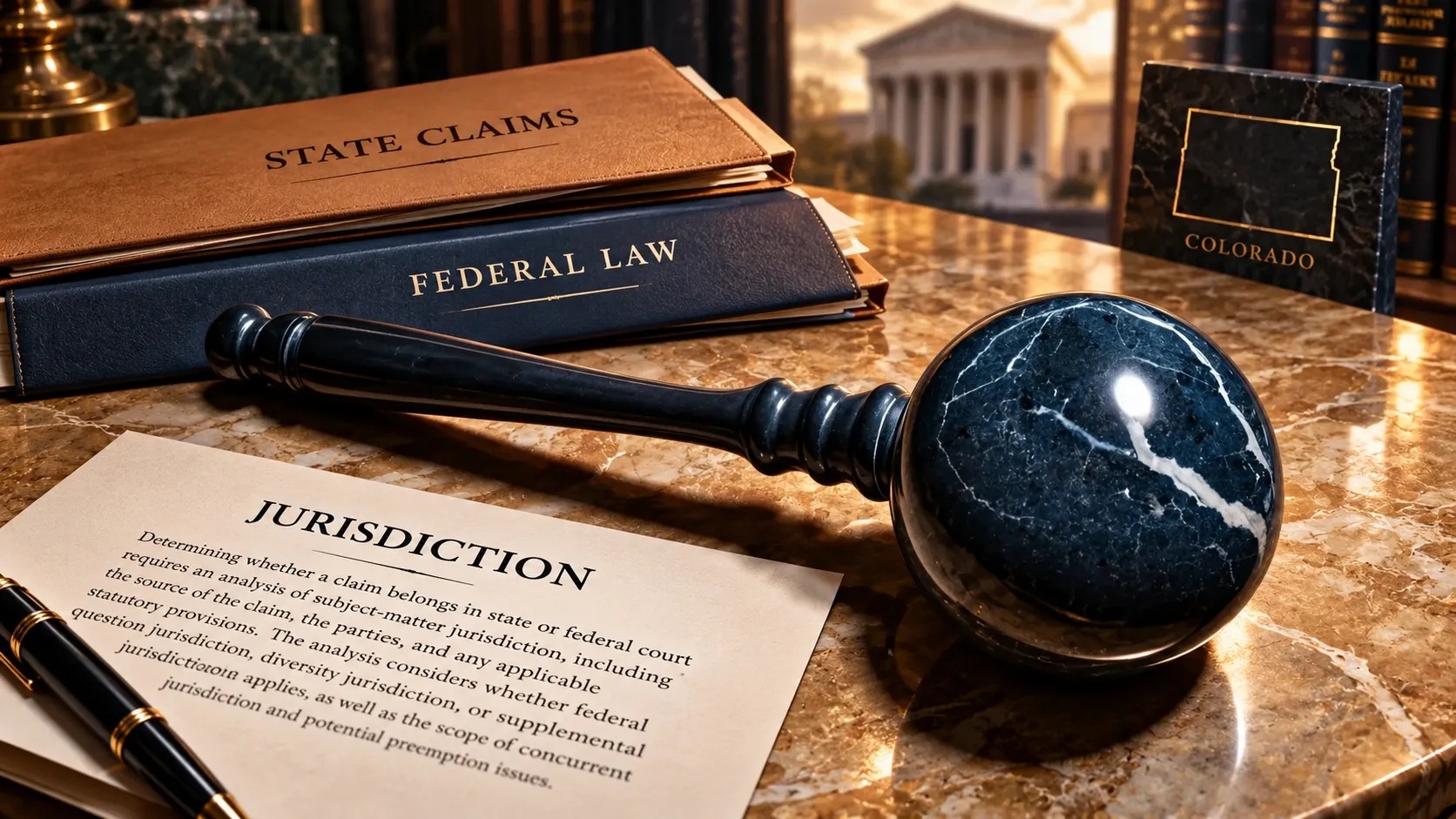
Beyond the substantive merits of preemption, the Court addressed procedural questions regarding its own jurisdiction to review the Colorado Supreme Court’s decision. The Colorado high court had previously ruled that federal law did not preempt Boulder’s claims, allowing the case to move forward in state court [4]scotusblog.comCourt sends mixed signals on whether it will allow state-tort suits seeking to hold energy companies liable for climate change to go forwardThe Supreme Court on Monday opened its new term by hearing arguments in a lawsuit filed in state court by the city and county of Boulder, Colorado, seeking to hold two major energy companies accountable for the costs of local climate…Open source ↗. Suncor and Exxon Mobil appealed this ruling, but Boulder’s attorneys urged the justices to dismiss the appeal on grounds that the Supreme Court lacks jurisdiction at this stage [1]cbsnews.comSupreme Court wrestles with energy companies' bid to block major climate-change lawsuitThe Supreme Court on Monday grappled with a complex dispute involving an effort by the city and county of Boulder, Colorado, to hold energy companies accountable for the effects of global climate change.Open source ↗. They argued that states have long possessed the power to provide tort remedies for injuries occurring within their borders, even when the causative conduct occurred elsewhere [7]yahoo.comSupreme Court appears skeptical energy companies can stop climate lawsuitSupreme Court appeared skeptical during oral arguments over whether energy companies could stop a lawsuit seeking billions of dollars in damages over alleged contributions to climate change.Open source ↗.
The Court also examined whether the case had reached a point ripe for review. Justice Clarence Thomas and Justice Jackson both raised doubts about the timing of the appeal, hinting that the dispute might still be in its early stages [8]law.stanford.eduWill the Supreme Court Create More Barriers to Climate Litigation? Analyzing Suncor v. Boulder Oral ArgumentsThe U.S. Supreme Court heard oral argument on Monday in Suncor Energy Inc. v. County Commissioners of Boulder County, a case involving an effort by the city and county of Boulder, Colorado, to hold fossil-fuel companies accountable for…Open source ↗. If the Court determines it lacks jurisdiction, the Colorado Supreme Court’s decision allowing the lawsuit to proceed would stand without establishing binding national precedent [5]nytimes.comThe justices will begin their new term with a landmark case about whether local governments can sue oil companies over damages caused by climate changeThe justices will begin their new term with a landmark case about whether local governments can sue oil companies over damages caused by climate change.Open source ↗. This procedural path would allow Boulder’s specific claims to advance while leaving the broader legal questions unresolved for other jurisdictions.
Compass Predictive Analytics
Potential Flood of Litigation and Economic Impact
A significant concern voiced by multiple justices was the potential for a flood of similar lawsuits if Boulder’s case is allowed to proceed. Chief Justice Roberts noted that if Boulder prevails, municipalities in every state would likely file identical lawsuits the following day [2]apnews.comThe Supreme Court is considering whether local governments can sue oil and gas companies for climate change costsThe Supreme Court is considering whether local governments can sue oil and gas companies for climate change costs.Open source ↗. He asked counsel how such a scenario would function on the ground, implying skepticism about the practicality of allowing a wave of local governments to sue national energy producers [5]nytimes.comThe justices will begin their new term with a landmark case about whether local governments can sue oil companies over damages caused by climate changeThe justices will begin their new term with a landmark case about whether local governments can sue oil companies over damages caused by climate change.Open source ↗.
Justice Kavanaugh expressed similar worries, stating that a win for Boulder could bankrupt oil companies and other potential defendants because any manufacturer or business could be sued under this theory [2]apnews.comThe Supreme Court is considering whether local governments can sue oil and gas companies for climate change costsThe Supreme Court is considering whether local governments can sue oil and gas companies for climate change costs.Open source ↗. Justice Clarence Thomas pressed the same point, asking whether, under Boulder's theory, governments could also sue large retailers of fossil fuels, and Russell acknowledged that nothing in the theory prevents that [4]scotusblog.comCourt sends mixed signals on whether it will allow state-tort suits seeking to hold energy companies liable for climate change to go forwardThe Supreme Court on Monday opened its new term by hearing arguments in a lawsuit filed in state court by the city and county of Boulder, Colorado, seeking to hold two major energy companies accountable for the costs of local climate…Open source ↗. Shanmugam reinforced this point during his rebuttal, suggesting that under Boulder’s theory, he could be sued for refilling his car in Colorado because it contributes to global climate change [4]scotusblog.comCourt sends mixed signals on whether it will allow state-tort suits seeking to hold energy companies liable for climate change to go forwardThe Supreme Court on Monday opened its new term by hearing arguments in a lawsuit filed in state court by the city and county of Boulder, Colorado, seeking to hold two major energy companies accountable for the costs of local climate…Open source ↗. He argued that the breadth of the plaintiff’s theory is astonishing and lacks limiting principles [7]yahoo.comSupreme Court appears skeptical energy companies can stop climate lawsuitSupreme Court appeared skeptical during oral arguments over whether energy companies could stop a lawsuit seeking billions of dollars in damages over alleged contributions to climate change.Open source ↗.
The economic stakes are substantial. The lawsuit seeks billions of dollars in damages for costs associated with extreme heat, wildfires, and ecosystem damage [1]cbsnews.comSupreme Court wrestles with energy companies' bid to block major climate-change lawsuitThe Supreme Court on Monday grappled with a complex dispute involving an effort by the city and county of Boulder, Colorado, to hold energy companies accountable for the effects of global climate change.Open source ↗[7]yahoo.comSupreme Court appears skeptical energy companies can stop climate lawsuitSupreme Court appeared skeptical during oral arguments over whether energy companies could stop a lawsuit seeking billions of dollars in damages over alleged contributions to climate change.Open source ↗. The 2021 Marshall Fire, which came years after Boulder first sued, destroyed nearly 1,100 homes in Colorado, with total damage estimated at $2 billion [2]apnews.comThe Supreme Court is considering whether local governments can sue oil and gas companies for climate change costsThe Supreme Court is considering whether local governments can sue oil and gas companies for climate change costs.Open source ↗. Shanmugam warned that allowing this case to go forward would greenlight dozens of other suits filed by more than 60 municipalities across the country [7]yahoo.comSupreme Court appears skeptical energy companies can stop climate lawsuitSupreme Court appeared skeptical during oral arguments over whether energy companies could stop a lawsuit seeking billions of dollars in damages over alleged contributions to climate change.Open source ↗. A senior legal fellow at Advancing American Freedom argued that a loss for the energy companies would have massively negative economic consequences, including exorbitant fuel prices and shortages [7]yahoo.comSupreme Court appears skeptical energy companies can stop climate lawsuitSupreme Court appeared skeptical during oral arguments over whether energy companies could stop a lawsuit seeking billions of dollars in damages over alleged contributions to climate change.Open source ↗.
Compass Predictive Analytics
Comparative Precedents: Tobacco and Opioid Litigation
Justice Elena Kagan described the current dispute as "Chapter 3" of a trilogy of cases, after tobacco and opioids, where states sued industries over broad societal harms [5]nytimes.comThe justices will begin their new term with a landmark case about whether local governments can sue oil companies over damages caused by climate changeThe justices will begin their new term with a landmark case about whether local governments can sue oil companies over damages caused by climate change.Open source ↗. Kagan noted that in the 1990s, states successfully sued tobacco companies for healthcare costs linked to smoking, and more recently, states pursued opioid makers for similar harms [6]grist.orgSupreme Court wrestles with who should pay for climate change: Suncor or Boulder?The Supreme Court opened its 2026-2027 term Monday with a climate case: a lawsuit brought by Boulder, Colorado, against Exxon Mobil and Suncor, a Canadian oil company, over the costs of a warming planet.Open source ↗. She questioned whether those earlier suits were also preempted by federal law, suggesting that the Court had allowed such state claims to proceed despite nationwide impacts [4]scotusblog.comCourt sends mixed signals on whether it will allow state-tort suits seeking to hold energy companies liable for climate change to go forwardThe Supreme Court on Monday opened its new term by hearing arguments in a lawsuit filed in state court by the city and county of Boulder, Colorado, seeking to hold two major energy companies accountable for the costs of local climate…Open source ↗.
Shanmugam replied that this was "a different book," stressing that the injury in Boulder’s case "is not suffered by the Colorado consumer in the traditional sense" and that the harms are "diffused nationwide and indeed worldwide" [4]scotusblog.comCourt sends mixed signals on whether it will allow state-tort suits seeking to hold energy companies liable for climate change to go forwardThe Supreme Court on Monday opened its new term by hearing arguments in a lawsuit filed in state court by the city and county of Boulder, Colorado, seeking to hold two major energy companies accountable for the costs of local climate…Open source ↗[2]apnews.comThe Supreme Court is considering whether local governments can sue oil and gas companies for climate change costsThe Supreme Court is considering whether local governments can sue oil and gas companies for climate change costs.Open source ↗. Shanmugam pointed back to the principle that federal law has traditionally governed claims involving interstate air and water pollution [4]scotusblog.comCourt sends mixed signals on whether it will allow state-tort suits seeking to hold energy companies liable for climate change to go forwardThe Supreme Court on Monday opened its new term by hearing arguments in a lawsuit filed in state court by the city and county of Boulder, Colorado, seeking to hold two major energy companies accountable for the costs of local climate…Open source ↗. He argued that resolving climate change requires political solutions rather than piecemeal litigation in state courts [6]grist.orgSupreme Court wrestles with who should pay for climate change: Suncor or Boulder?The Supreme Court opened its 2026-2027 term Monday with a climate case: a lawsuit brought by Boulder, Colorado, against Exxon Mobil and Suncor, a Canadian oil company, over the costs of a warming planet.Open source ↗.
Kevin Russell, representing Boulder, countered that the lawsuit is not an attempt to regulate emissions or stop production but to hold companies accountable for deceptive marketing [1]cbsnews.comSupreme Court wrestles with energy companies' bid to block major climate-change lawsuitThe Supreme Court on Monday grappled with a complex dispute involving an effort by the city and county of Boulder, Colorado, to hold energy companies accountable for the effects of global climate change.Open source ↗. He argued that under their theory, energy companies could continue producing fossil fuels as long as consumers are properly informed of the consequences [1]cbsnews.comSupreme Court wrestles with energy companies' bid to block major climate-change lawsuitThe Supreme Court on Monday grappled with a complex dispute involving an effort by the city and county of Boulder, Colorado, to hold energy companies accountable for the effects of global climate change.Open source ↗. Russell emphasized that the suit seeks to internalize a portion of the cost of these activities by requiring payment for damages inflicted, rather than prohibiting the conduct itself [4]scotusblog.comCourt sends mixed signals on whether it will allow state-tort suits seeking to hold energy companies liable for climate change to go forwardThe Supreme Court on Monday opened its new term by hearing arguments in a lawsuit filed in state court by the city and county of Boulder, Colorado, seeking to hold two major energy companies accountable for the costs of local climate…Open source ↗. This distinction was crucial to his argument that state tort law remains applicable even when the underlying product causes global harm.
Compass Predictive Analytics

Conclusion and Strategic Implications
The Supreme Court’s oral arguments in Suncor Energy v. Commissioners of Boulder County revealed a court deeply conflicted over how to balance federal environmental authority with state tort remedies. While energy companies argued that the Clean Air Act preempts state claims, several justices expressed skepticism of that position, while others worried about the potential for unlimited liability under Boulder's theory [7]yahoo.comSupreme Court appears skeptical energy companies can stop climate lawsuitSupreme Court appeared skeptical during oral arguments over whether energy companies could stop a lawsuit seeking billions of dollars in damages over alleged contributions to climate change.Open source ↗. The Court also weighed procedural questions regarding jurisdiction, with some justices suggesting the case might be premature for review [8]law.stanford.eduWill the Supreme Court Create More Barriers to Climate Litigation? Analyzing Suncor v. Boulder Oral ArgumentsThe U.S. Supreme Court heard oral argument on Monday in Suncor Energy Inc. v. County Commissioners of Boulder County, a case involving an effort by the city and county of Boulder, Colorado, to hold fossil-fuel companies accountable for…Open source ↗.
Justice Samuel Alito recused himself without giving a reason, which leaves the possibility of a 4-4 tie [1]cbsnews.comSupreme Court wrestles with energy companies' bid to block major climate-change lawsuitThe Supreme Court on Monday grappled with a complex dispute involving an effort by the city and county of Boulder, Colorado, to hold energy companies accountable for the effects of global climate change.Open source ↗. A deadlock would leave the Colorado Supreme Court’s decision allowing the lawsuit to proceed in place, though it would not set binding national precedent [5]nytimes.comThe justices will begin their new term with a landmark case about whether local governments can sue oil companies over damages caused by climate changeThe justices will begin their new term with a landmark case about whether local governments can sue oil companies over damages caused by climate change.Open source ↗. This outcome would allow Boulder’s specific claims to advance while leaving the broader legal questions unresolved for other jurisdictions.
The decision will likely come by summer 2027 [1]cbsnews.comSupreme Court wrestles with energy companies' bid to block major climate-change lawsuitThe Supreme Court on Monday grappled with a complex dispute involving an effort by the city and county of Boulder, Colorado, to hold energy companies accountable for the effects of global climate change.Open source ↗. If the Court rules against preemption, Boulder's case and similar suits could proceed, though more litigation over the specifics would follow [6]grist.orgSupreme Court wrestles with who should pay for climate change: Suncor or Boulder?The Supreme Court opened its 2026-2027 term Monday with a climate case: a lawsuit brought by Boulder, Colorado, against Exxon Mobil and Suncor, a Canadian oil company, over the costs of a warming planet.Open source ↗. Conversely, a ruling in favor of the energy companies could shut down dozens of similar cases [2]apnews.comThe Supreme Court is considering whether local governments can sue oil and gas companies for climate change costsThe Supreme Court is considering whether local governments can sue oil and gas companies for climate change costs.Open source ↗. The Court’s reasoning will also impact other industries facing similar deception claims, potentially shielding or exposing them to liability depending on how broadly the justices define the limits of state authority.
Ultimately, the case represents a critical juncture in American environmental law. It forces the Court to decide whether local governments can use tort law to address global problems or if such issues must remain exclusively within federal purview. The mixed signals sent during arguments leave the outcome uncertain, and with it the future of climate litigation.
Compass Predictive Analytics